

Box Build RFQ Checklist — What to Send Your Manufacturer

Which Box Build Assembly Requirements Belong in an RFQ?
Group your box build assembly requirements into six parts for a request for quotation (RFQ). Send the board bill of materials (BOM) and Gerber files if the supplier will build the board. Include mechanical drawings, harness specifications, firmware and test requirements, labeling and packaging instructions, and expected annual volume. A missing item can delay the quote or change what the price covers.
When you request box build services, start with what you expect to unpack. For a benchtop controller, that might be a programmed unit with a working front-panel button, a readable serial label, and the right cable in the carton. Put the finished product’s part number and revision on the RFQ cover sheet. If your team is still deciding which operations to outsource, our guide answers the question “what is box build assembly?”

Box Build RFQ Checklist by Input and File Format
Use a top-level BOM to list everything that goes into one finished product. Include the printed circuit board assembly (PCBA), enclosure, harnesses, hardware, and packed accessories. Mark who supplies each item. The following files let an electronics manufacturing services (EMS) provider price the parts it must buy and the work it must perform.
Purchasing checklist for a finished box build
| Input | File format | Why it matters |
|---|---|---|
| System BOM and PCBA package | XLSX or CSV parts list. For board builds, Gerbers, NC drill files, placement data, and an assembly drawing. | Defines quantities, approved parts, and whether the price includes board fabrication and assembly. |
| Enclosure, brackets, and fasteners | STEP model, dimensioned PDF drawings, and hardware part numbers. | Shows how the board mounts and which cutouts, finishes, or inserts require extra work. |
| Cables, harnesses, and connectors | Harness drawing in PDF and a pin-to-pin list in XLSX or CSV. | Identifies terminals, wire, lengths, and connections to inspect before closing the housing. |
| Firmware, test, and acceptance | PDF programming and test instructions, firmware release ID and file type, and a sample results file in CSV. | Defines fixture needs, operator time, and the evidence required to release a unit. |
| Labels, packaging, and shipping | Label artwork in PDF or vector format, a packing drawing or photos, and shipping instructions. | Specifies what travels with each unit and what the receiving team must scan or inspect. |
| Annual volume and order schedule | Spreadsheet or RFQ cover sheet with pilot quantity, release sizes, forecast, and required dates. | Lets suppliers quote buying quantities, setup costs, and delivery schedules on the same basis. |
If you supply tested PCBAs, identify the board revision, delivery condition, mounting details, and incoming checks. If the EMS will build them, include the board files in the package and list any approved component alternatives. For turnkey box build assembly, identify exceptions such as a customer-supplied cable. A short file index can tie each product variant to its board, harness, enclosure, and firmware revisions.
Distinguish a production lot from a shipment. An annual forecast of 1,200 units could mean a single build shipped in monthly lots of 100, or a new build every month. Monthly builds can add setup time. A single build with staggered shipments can add storage costs. Ask for one-time charges and the unit price at each release quantity so you can compare offers.
Mechanical Drawings and Enclosure Details
For a catalog enclosure, give the manufacturer’s orderable part number, color, finish, and any changes to the stock part. Show the front-panel cutouts and their locations relative to a mounting hole or another defined reference. The supplier can then check whether a board-mounted connector lines up with the opening after the board is screwed down.
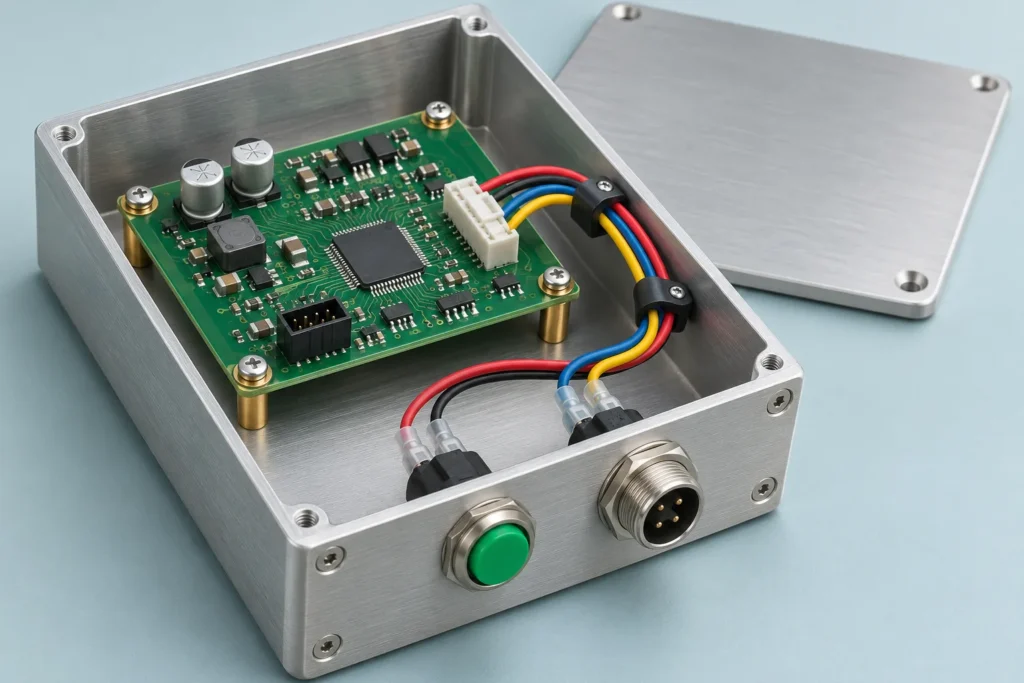
Check what comes in the enclosure kit. For example, Hammond’s 1593K enclosure drawing includes the cover screws with the case and lists the PCB mounting screws as accessories. Give the mounting screws their own BOM line if your design uses them. If you supply those screws yourself, mark them accordingly so the quote still covers installation labor.
For a custom enclosure, send a dimensioned drawing alongside the model. Mark the features that control fit, the finish on visible faces, and any fastening torque your engineering team specifies. Identify who will approve the first assembled sample before the supplier orders parts for the full run.
Cable, Harness, and Connector Specifications
For each cable branch, give the connector and terminal part numbers at both ends. Show the pin numbers from a labeled viewing direction. Define where the length measurement starts and ends, along with its tolerance. A harness drawing for a lid-mounted button should show the route and how much slack it needs when the lid opens for service.
A wire gauge alone can leave the crimp contact undecided. In JST’s XH connector data sheet, both SXH-002T-P0.6 and SXH-001T-P0.6N accept a 26 AWG conductor. Their insulation diameter ranges differ. The first accepts 0.9–1.3 mm (about 35–51 mil), and the second accepts 1.3–1.9 mm (about 51–75 mil). Listing the wire part number and the full contact number gives purchasing a precise match.
For outsourced wire harness assembly, specify the continuity checks and records you want. If the contract calls for IPC/WHMA-A-620 harness acceptance criteria, state the agreed revision and class. Supply the product pinout as well so the test team knows which terminals must connect.
Firmware, Test, and Acceptance Criteria
Identify the firmware release for each hardware revision and product variant. Include the approved programming file, such as a HEX or BIN image, or give its expected release date. Describe the programming interface, who supplies the tool, and how the operator verifies the loaded version. If the cover hides the programming header, mark the last assembly step where the operator can reach it. If the supplier needs a special fixture, ask for its design and setup cost separately from the programming cost per unit.
Give each final test an action, a pass condition, and a result to record. For the controller, an operator might press the button on the closed enclosure, check that the front-panel indicator turns green, and log the result against the unit serial number. That step exercises the installed button and harness as well as the board. Define any timing limit in the product test specification.
For functional testing, specify which checks run on the board and which run after installation. State whether every unit or a defined sample is tested. Include a sample report and name the person who can approve a deviation. The supplier can use those details to estimate test time and quote the required records.
Labeling, Packaging, and Shipping Instructions
Send approved label artwork, a placement drawing, and the data the printer must add for each unit. If your customer uses GS1 barcodes, the GS1 application identifier directory lists 01 for the Global Trade Item Number and 21 for the serial number. Provide an example of the decoded text so the packer can verify it against the unit’s test record. State who issues serial numbers and handles reprints.
List the cables, manuals, and accessories that go in each carton. Specify protective packing, quantity per carton, carton markings, and destination. If variants share an enclosure but ship with different cables, match each finished part number to its packing list. Include the required arrival date and ask the supplier to show freight separately.
When requesting box build assembly services, flag any open item with its owner and expected decision date. Send your box build files with that list so the quotation can identify the assumptions behind the price.
FAQ
What documents are needed for a box build quote?
Provide a system BOM, the board package or details of your supplied PCBA, enclosure drawings, a harness pinout, and firmware and test instructions. Include label artwork, a packing list, order quantities, and delivery dates. A file index should identify the revision that applies to each finished product.
Can a manufacturer source the enclosure for a box build?
Yes, enclosure sourcing can be part of the quote. For a standard case, give the exact part number and a drawing for any modifications. For a custom housing, supply the material, dimensions, finish, and acceptance criteria. Ask the manufacturer to identify tooling charges and who owns the tooling. If the housing will be made by injection molding, agree on the resin and sample acceptance criteria before tooling begins.
How is box build assembly priced?
An electromechanical assembly quote typically separates recurring costs from one-time charges. Recurring costs can cover purchased parts, integration labor, programming, testing, and packing. One-time charges can cover tooling, fixtures, and test development. Compare the same batch size, sourcing responsibilities, and delivery terms when reviewing the unit prices.
What testing is included in box build?
The agreed test plan defines what is included. It may cover harness continuity, firmware verification, or checks on the finished unit through its external controls and ports. Ask the supplier to identify the test stage, equipment, pass limits, and results it will record for each serial number or lot.
Ready to Quote Your Box Build?
Send your BOM, drawings and test requirements and Benlida will review them for free.