

Ceramic PCB vs FR-4 — Which Material Is Right for Your Application?
Choosing between a ceramic PCB and an FR-4 PCB is mainly a thermal and reliability decision. FR-4 is the practical choice for most electronics. It is affordable, easy to process, and well suited to complex multilayer boards. Ceramic PCB material becomes valuable when heat, high temperature, electrical isolation, or thermal expansion could limit product life.
This guide compares thermal conductivity, Tg, CTE, dielectric properties, operating temperature, and cost. It also explains when alumina or aluminum nitride is worth the premium.
Quick Answer
Choose FR-4 for most consumer, communication, control, and low-to-medium-power products. It supports dense routing and keeps board cost under control.
Choose alumina ceramic when you need much better heat transfer and electrical insulation, but still need to control ceramic substrate cost.
Choose aluminum nitride ceramic when heat flux is very high or when matching the thermal expansion of power semiconductors is critical.
Ceramic is not an automatic upgrade. It is brittle and costs more. Choose from the full thermal path, not one value.
What Is a Ceramic PCB?
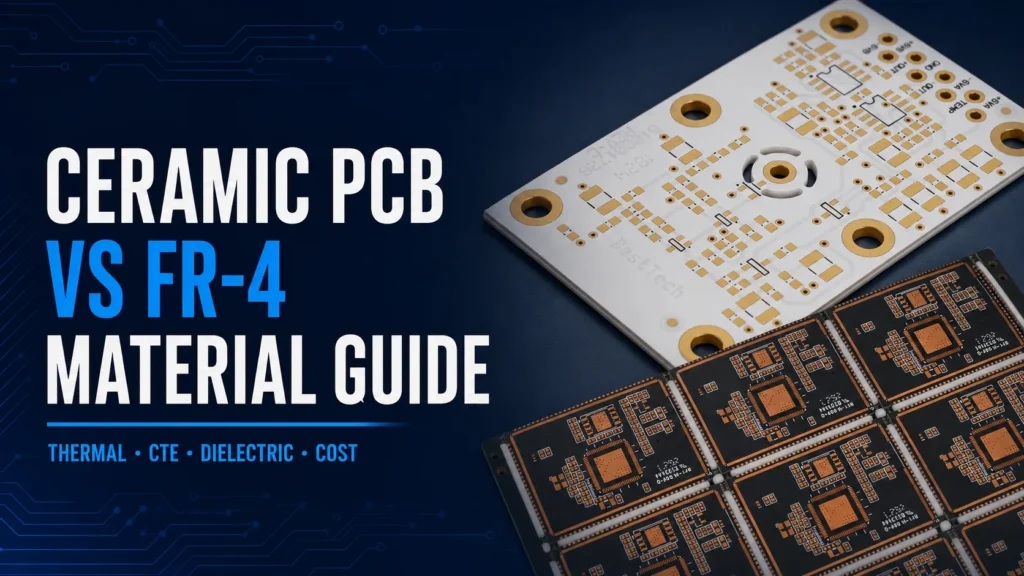
A ceramic PCB uses an insulating ceramic substrate. Copper or another conductor forms the circuit. The substrate also moves heat away from hot components.
Two common ceramic PCB materials are aluminum oxide and aluminum nitride:
- Aluminum oxide (Al2O3), or alumina: This is the established, cost-conscious ceramic option. It offers strong electrical insulation and much better thermal conductivity than FR-4.
- Aluminum nitride (AlN): This material provides a much higher level of heat transfer. Its coefficient of thermal expansion is also close to that of many semiconductor materials.
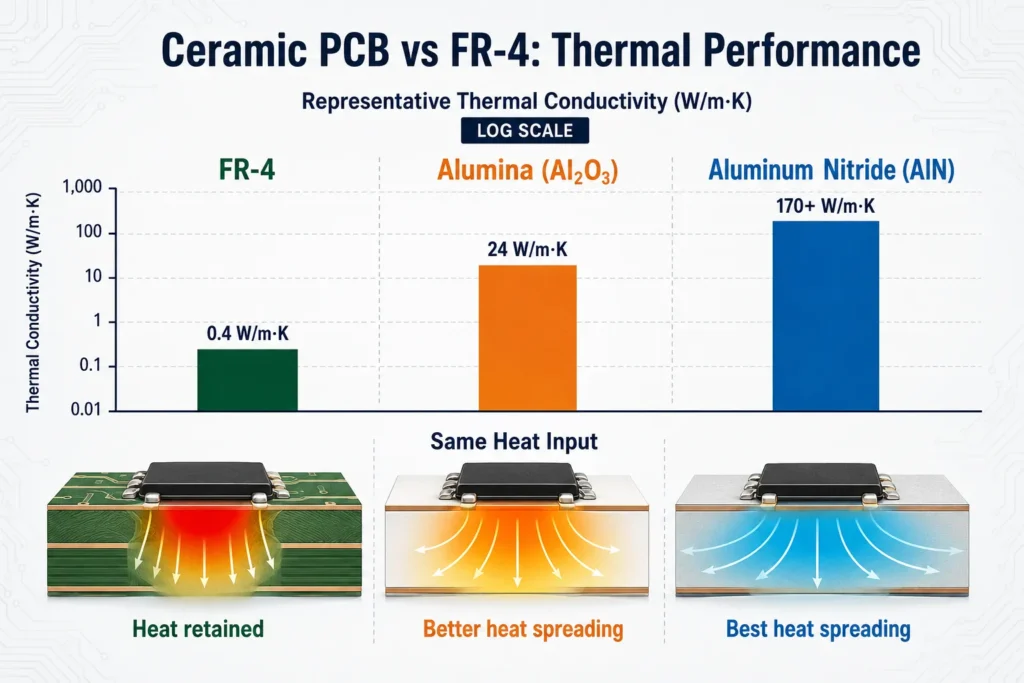
Representative substrate data shows why the distinction matters. CeramTec lists about 24 W/m·K thermal conductivity for 96% alumina. The same manufacturer lists at least 170 W/m·K for AlN. You can review the source data for alumina substrates and AlN substrates.
Ceramic PCB is different from metal-core PCB. Ceramic acts as both the electrical insulator and the heat-transfer layer. A metal-core board uses a separate dielectric over an aluminum or copper base.
What Is FR-4?
FR-4 is a family of flame-retardant, woven-glass epoxy laminates. It is the standard base for many rigid printed circuit boards.
FR-4 balances price, mechanical strength, electrical insulation, and manufacturability. It supports simple two-layer boards and complex multilayer stack-ups.
FR-4 is not one exact material grade. Its glass transition temperature, dielectric constant, loss, thermal expansion, and reliability vary by laminate system. For example, the Isola 370HR laminate data lists a Tg of 180°C, thermal conductivity of 0.4 W/m·K, and an X/Y-axis CTE of 13/14 ppm/°C before Tg. Another FR-4 grade may have different values.
Always compare the selected datasheet, not only the general label “FR-4.” Benlida can review laminate options as part of FR-4 PCB manufacturing.
Ceramic PCB vs FR-4: Key Property Comparison
These are representative values. Results vary by grade, purity, thickness, test method, frequency, and board construction.
| Property | FR-4 | Alumina | Aluminum Nitride |
|---|---|---|---|
| Thermal conductivity | About 0.3–0.4 W/m·K | About 24 W/m·K | About 170 W/m·K or higher |
| Glass transition temperature (Tg) | Often 130–180°C or higher, depending on grade | Not applicable | Not applicable |
| CTE | About 13–17 ppm/°C in X/Y; much higher in Z | About 7–9 ppm/K | About 5–6 ppm/K |
| Dielectric constant (Dk) | About 4; varies by grade and test frequency | About 9.8 at 1 MHz | About 8.5 at 1 MHz |
| Continuous temperature reference | Material-specific; 130°C RTI for the representative 370HR grade | No universal PCB rating; limited by the full assembly | No universal PCB rating; limited by the full assembly |
| Mechanical behavior | Tough, machinable, and suited to large or complex multilayer boards | Rigid and brittle | Rigid and brittle |
| Relative board cost | Lowest | Higher | Usually highest |
Thermal Conductivity
Thermal conductivity shows how easily heat moves through a material. A higher number usually means a lower temperature rise across the substrate, if thickness and area stay the same.
For a high thermal conductivity PCB, representative AlN offers more than 400 times the conductivity of the example FR-4 laminate. Alumina is also far more conductive. Copper, vias, solder, airflow, and the heat sink still affect final temperature.
Glass Transition Temperature and Operating Temperature
Tg is the temperature region where the resin in FR-4 changes from a hard state to a softer state. Above Tg, expansion increases and dimensional stability falls. Ceramic has no polymer resin, so Tg does not apply.
Tg is not the maximum continuous operating temperature. Check the laminate’s Relative Thermal Index, or RTI, plus the limits of solder joints, coatings, connectors, and components. A ceramic assembly is still limited by its metallization and mounted parts.
Coefficient of Thermal Expansion
CTE describes how much a material expands as temperature rises. Lower and better-matched CTE can reduce stress between a semiconductor and its substrate.
AlN is attractive for power modules because its CTE is close to many chip materials. FR-4 expands more, especially through its thickness. Repeated thermal cycling can therefore place more stress on vias, solder joints, and component connections.
Dielectric Properties
FR-4 commonly has a lower dielectric constant than alumina or AlN. This affects trace impedance, electrical length, and the physical size of RF structures. Test frequency and method also change the reported value, so the numbers in the table are not direct RF design inputs.
Ceramic is not always best for high-frequency circuits. Loss tangent, conductor roughness, and tolerance also matter. Select automotive radar material from the frequency, loss, power, and thermal requirements.
When to Use Ceramic PCB
Use ceramic when an FR-4 thermal solution would become too large or unreliable. The following applications often benefit.
High-Power LEDs and Laser Modules
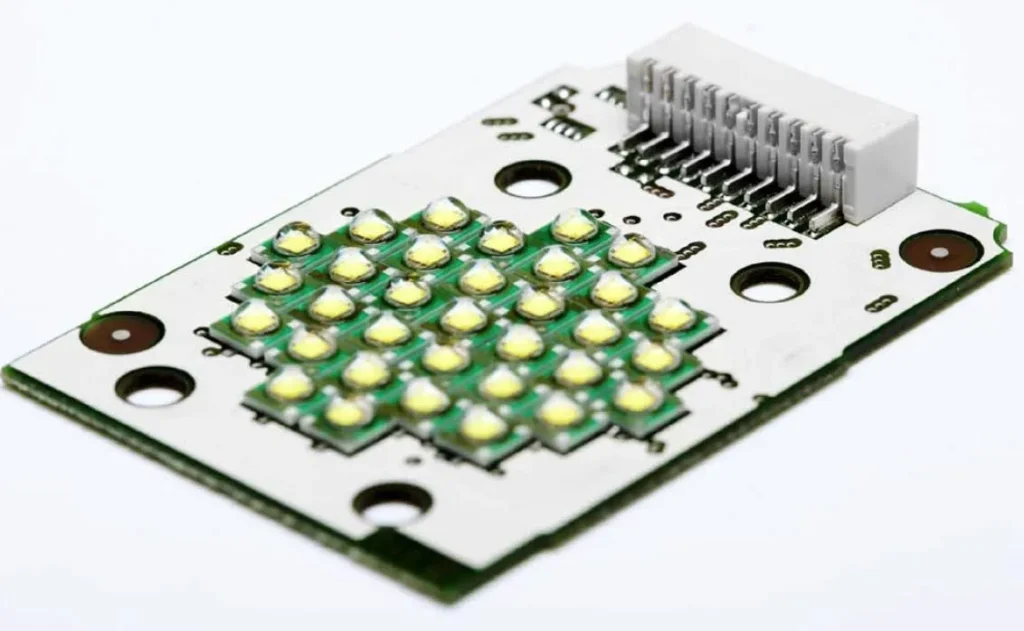
LED efficiency and lifetime fall when junction temperature is too high. AlN moves concentrated heat while keeping electrical isolation. Alumina may be enough for moderate loads.
Lower-power lighting may still use aluminum-core or optimized FR-4 boards. Compare production options with an experienced LED PCB manufacturer.
Power Electronics
Inverters, motor drives, IGBT modules, MOSFET modules, and power supplies can create intense local heat. Ceramic provides insulation and a short path to a heat sink. Low CTE can also improve power-cycling reliability.
Automotive Radar and RF Modules
Some radar and RF modules need stable dimensions and effective heat removal. Ceramic may fit. Low-loss organic RF laminates may be better when signal loss is the main concern.
High-Temperature or Harsh Environments
Ceramic substrates resist heat, chemicals, and moisture better than common epoxy laminates. They can support sensors, heaters, and electronics near hot equipment. Qualify the whole assembly for the target environment.
Strong signs that ceramic deserves evaluation include:
- Thermal simulation predicts a component junction temperature above its limit.
- FR-4 would require too many thermal vias, a large heat sink, or forced airflow.
- Thermal cycling creates solder, via, or die-attach reliability risks.
- The design needs electrical isolation directly in a high-heat path.
- Available area is too small for the required heat spreading.
When FR-4 Is Sufficient
FR-4 is sufficient when components stay within their rated temperatures and normal thermal design can meet the required life.
Typical FR-4 applications include:
- Consumer electronics and smart home products
- IoT devices and low-power wireless modules
- Control boards and industrial interfaces
- Communication equipment with manageable heat loads
- Dense multilayer boards that need many signals, vias, and power planes
- High-volume products with strict cost targets
FR-4 thermal performance can often be improved with copper pours, thicker copper, thermal vias, heat spreaders, heat sinks, or airflow. High-Tg laminate can improve thermal reliability, but it does not transfer heat like ceramic.
If these methods cannot control temperature, compare ceramic with metal-core PCB. Metal-core material may suit some LED and power designs.
Cost Difference: Ceramic PCB vs FR-4
Ceramic PCB normally costs more than FR-4. There is no universal price multiplier. Size, ceramic type, copper method, tolerances, volume, and testing all change the quote.
Several factors raise ceramic board cost:
- Alumina and AlN cost more than standard FR-4 laminate.
- Metallization methods need specialized processes.
- Brittle material needs controlled handling and machining.
- Laser drilling or profiling may be needed.
Alumina usually offers the better price-to-performance balance within the ceramic family. AlN is justified when its much higher thermal conductivity or closer CTE match solves a real reliability problem.
Compare total system cost, not only bare-board price. Ceramic may shrink a heat sink, remove a fan, simplify insulation, or extend product life.
How to Choose the Right PCB Material
- Define the heat source. Record power loss, heat area, duty cycle, and worst-case ambient temperature.
- Set temperature limits. Include junction, case, board, and enclosure limits.
- Model the thermal path. Include copper, vias, solder, interface material, heat sink, and airflow.
- Check other needs. Review isolation, impedance, loss, CTE, vibration, size, and layer count.
- Compare total cost. Include fabrication, assembly, cooling hardware, yield, and reliability risk.
- Test prototypes. Use thermal imaging, power cycling, and environmental testing.
For a useful review, provide Gerber files, stack-up, copper thickness, dimensions, volume, operating temperature, and heat-source details. An experienced ceramic PCB manufacturer can then suggest a practical construction.
Frequently Asked Questions
Is ceramic PCB always better than FR-4?
No. Ceramic transfers heat better and has a lower CTE, but it costs more and is brittle. FR-4 is usually better for cost-sensitive products, dense multilayer routing, and low-to-medium heat loads.
How much better is ceramic PCB at heat dissipation?
Representative 96% alumina has about 24 W/m·K thermal conductivity. Representative AlN has about 170 W/m·K or more. Typical FR-4 is around 0.3–0.4 W/m·K. Actual component temperature still depends on the complete board and cooling design.
What is the difference between aluminum nitride PCB and FR-4?
The aluminum nitride PCB vs FR-4 choice is a clear trade-off. AlN offers far higher thermal conductivity and lower CTE. FR-4 is cheaper, less brittle, and easier for complex multilayer circuits.
Should I choose alumina or aluminum nitride ceramic?
Choose alumina when 24 W/m·K class conductivity is enough and cost matters. Choose AlN when the design needs much faster heat transfer or closer CTE matching to semiconductor devices. Confirm the choice with a thermal model and prototype test.
Can FR-4 be used for high-power LED boards?
It can work for lower or moderate power if copper, thermal vias, and cooling are designed correctly. For concentrated high-power LEDs, metal-core or ceramic substrates often provide a shorter and more reliable heat path.
Need Help Comparing Ceramic PCB and FR-4?
The best material is the one that meets your temperature, electrical, reliability, and cost targets with enough design margin. Benlida can review your application, material options, stack-up, and production requirements. Get a ceramic PCB quote and include your heat-load and operating-temperature data for a more useful recommendation.