

Industrial Control PCB Case Study — Cost Reduction Through Component Optimization

Case Study Overview
Benlida helped an industrial control equipment manufacturer reduce production cost through component substitution and process optimization. The program maintained its reliability requirements. Design for manufacturability (DFM) review and Shenzhen sourcing support contributed to savings for repeat production orders.
This industrial control PCB case study presents the outcome in qualitative terms. It does not disclose customer identity, component part numbers, unit prices, or a savings percentage. The confirmed result is lower production cost while maintaining the project’s reliability requirements. The engineering guidance below explains how other buyers can assess similar opportunities.
The distinction between PCB and PCBA matters here. A PCB is the bare board. A PCBA includes its installed components. This case concerns an assembled-board program, where component choices and assembly processes both influence production cost.
The Challenge — Cost Pressure on an Industrial Control Program
The customer needed to reduce cost on an industrial control program. Reliability requirements remained a constraint. The opportunity was to review component choices and assembly processes together, instead of treating the component purchase price as the whole cost problem.
For industrial control buyers, a lower price is useful only if the revised build remains suitable for its application. A controller may need to work across temperature changes, electrical noise, or variable loads. The relevant conditions depend on the product and where it will operate.
A useful starting point is a consistent comparison. Keep the product revision, order quantity, quality requirements, and included services clear. Otherwise, a cheaper quotation may reflect a smaller scope rather than an improvement to the design or production process.
It also helps to separate the cost categories. Component purchases, board fabrication, assembly work, and testing create different opportunities. Our industrial control PCB design guide explains the design considerations that should remain visible during that review.
Component Optimization Approach
Component substitution was one part of the confirmed cost reduction. The public case summary does not identify the original or replacement parts. Buyers considering a similar change should therefore use the outcome as a reason to investigate their own BOM, not as approval to substitute a particular component.
Start with the bill of materials, or BOM, and the requirements that each part must meet. Review purchase cost alongside availability, package suitability, and the work needed to approve a change. A lower-priced part may provide little benefit if it requires substantial redesign or new tooling.
A matching footprint is not enough. TI’s cross-reference guidance distinguishes drop-in replacements, pin-compatible devices, and parts with similar functions. Even matching pins can come with different specifications. A search result is a candidate for engineering review, not a completed equivalence check.
Define the characteristics that cannot change. Depending on the circuit, these may include voltage and current limits, power dissipation, accuracy, timing, or operating temperature. Altium’s replacement-component guidance recommends checking the original design requirements before selecting alternatives.
Sourcing also needs a quality review. TI’s purchasing guidance highlights the risks of unverified channels, including authenticity and handling. A supplier’s location alone does not establish component quality. Ask how proposed parts will be sourced and identified.
For each candidate, ask for a short comparison against the original part. Record important differences, the proposed source, and any drawing or software changes that would be needed. This makes an alternative easier to review across engineering, purchasing, and quality teams. Keep the original approved configuration available so production does not accidentally mix versions.
Benlida’s alternative component sourcing service provides a starting point for that discussion. Submit the current BOM and identify which substitutions need customer approval. Keep proposed alternatives separate from the approved production list until the relevant review is complete.
Process Improvements Applied During Assembly
Process optimization was the second part of the program. It worked alongside component substitution to reduce production cost. Specific equipment settings, assembly steps, and cycle-time changes are not disclosed in this case.
For another design, the practical lesson is to review how component choices affect assembly work. A purchasing change can alter placement, soldering, inspection, or handling needs. Those effects belong in the cost comparison before a replacement is approved.
Eurocircuits’ assembly data-preparation guidance describes reviewing BOM and placement data against package, layout, orientation, and production requirements. This shows why manufacturability review should connect purchasing information with the physical board.
Useful review questions include:
- Does the selected package suit the planned placement and soldering process?
- Are orientation and polarity instructions clear?
- Could a design choice create avoidable manual handling or difficult inspection?
- Will the change affect test access, fixtures, or programming?
- Do the BOM, assembly drawing, and placement files describe the same revision?
These are general review questions, not a list of changes reported for this customer. Their purpose is to find costs that a component price comparison can miss.
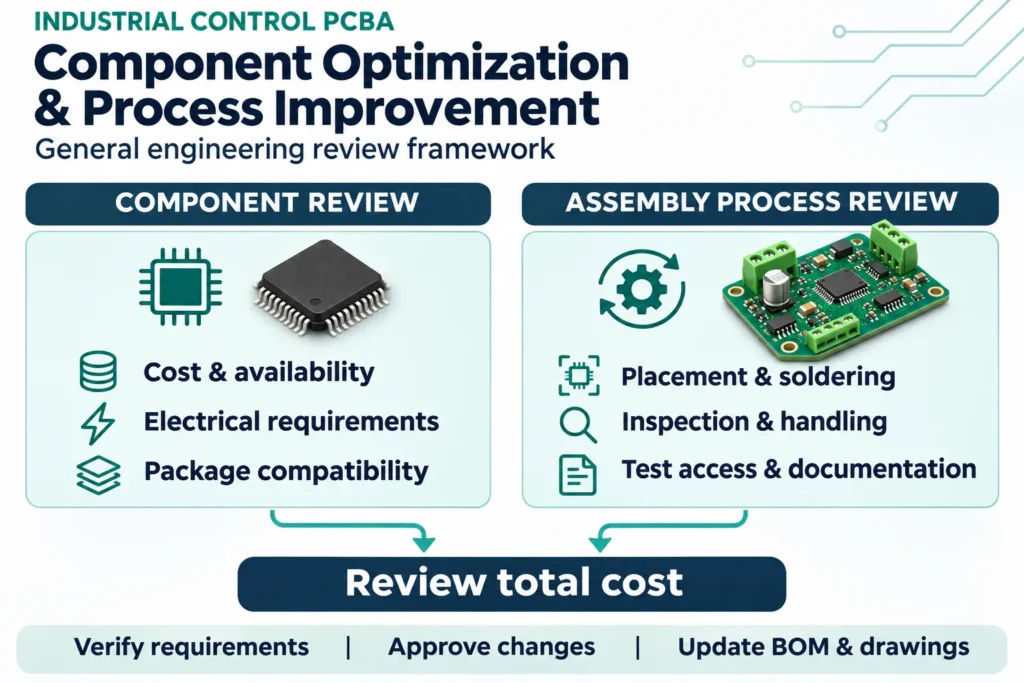
For an existing design, request a DFM review with the current files and cost priorities. Agree on which proposed changes need approval before production documentation is updated.
Results — Cost and Reliability Outcomes
The confirmed outcome was reduced production cost through component substitution and process optimization. The program’s reliability requirements were maintained. The table summarizes the changes and their outcomes. Monetary details are not disclosed.
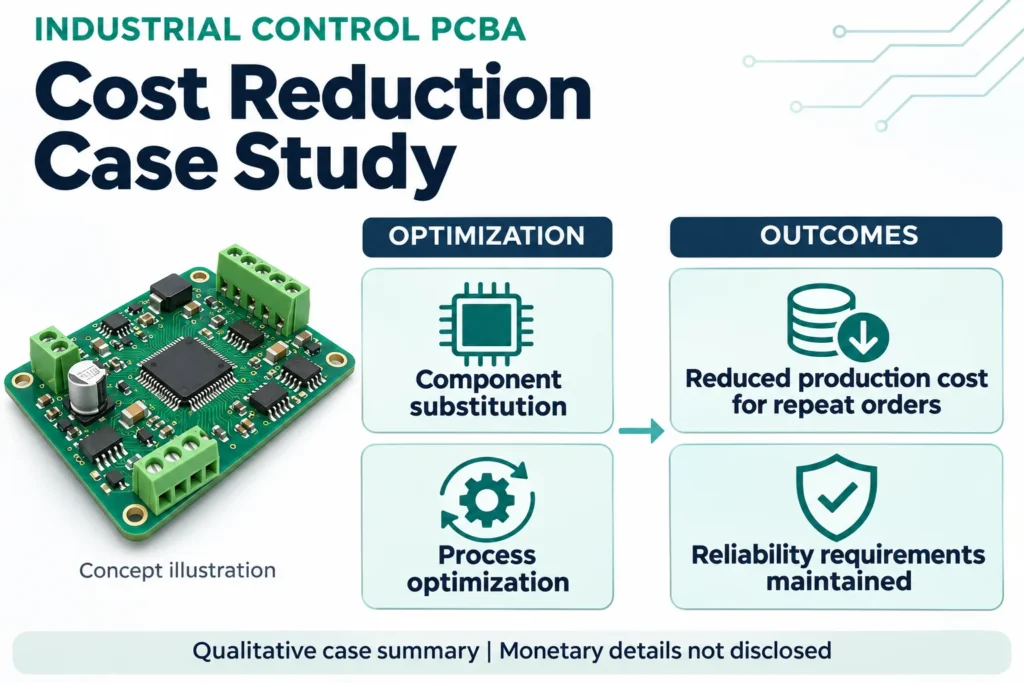
Case Study Results
| Metric | Before | After |
|---|---|---|
| Production cost | Cost pressure on the existing program. | Reduced production cost for repeat orders. |
| Component selection | Original component selection. | Component substitutions contributed to the cost reduction. |
| Assembly process | Original production process. | Process optimization contributed to the cost reduction. |
| Reliability requirements | Existing project requirements. | Requirements maintained after optimization. |
Maintaining reliability requirements is not the same as publishing a measured improvement in field reliability. This case does not provide failure-rate, lifetime, or yield data. It should not be read as a promise that every industrial control design can achieve the same result.
When evaluating a proposal for your own program, agree on the verification plan before approving a change. Different checks answer different questions. Synopsys’ test-equipment overview distinguishes electrical connection checks from powered functional testing. For a proposed design change, choose checks that address the functions and risks affected by that change.
Lessons for Other Industrial Control Buyers
The main lesson is to evaluate the component and the assembly process together. A useful cost reduction must survive the full review, including the expense of approving and introducing the change.
For a repeat-production program, consider the following steps:
- Set the baseline: record the current revision, quantity, sourcing scope, and accepted requirements.
- Define the constraints: identify functions, interfaces, environmental conditions, and parts that cannot change.
- Compare complete costs: include validation, tooling, assembly, and testing alongside component purchases.
- Control approval: document accepted alternatives and update the released BOM and drawings together.
- Review the result: compare the agreed cost scope and verification evidence before extending a change to repeat orders.
Separate one-time introduction costs from recurring unit savings. A change that looks attractive over many repeat orders may offer little benefit for a small remaining production run. Use your own expected volume rather than borrowing a savings assumption from another customer’s project.
Ask what could change the commercial comparison over time. Component availability, order frequency, and the remaining product life can affect whether an alternative remains useful. Set a review point when those assumptions change, and keep purchasing decisions tied to the currently approved build.
To start a focused discussion, share the BOM, Gerber files, assembly drawings, quantity, and current cost concerns. Add the reliability requirements and any restrictions on substitutions. Discuss a cost optimization review with Benlida using that current project package.
FAQ
How does component optimization reduce PCB assembly cost?
Approved alternatives may reduce component purchase cost or better suit the assembly process. The useful saving is the net benefit after validation, tooling, production, and testing costs. Compare the same quantity and scope before and after a proposed change.
Does cost optimization affect reliability on industrial control boards?
It can if changes are not reviewed properly. Keep the required performance and operating conditions fixed, then verify proposed changes against them. This Benlida case maintained its reliability requirements, but that outcome does not replace validation for a different design.
What role does DFM review play in cost reduction?
DFM review connects design choices with manufacturing needs. For an assembly program, it can reveal package, layout, documentation, or process issues worth addressing. It helps teams evaluate production consequences before accepting a lower-priced component.
Can Benlida review an existing design for cost savings?
Yes. Share the current design files, BOM, quantities, and requirements for an engineering review. Identify the costs you want to address and any parts that must remain unchanged. Potential savings depend on the available, acceptable changes for that program.
Facing Cost Pressure on an Industrial Control Program?
Benlida’s DFM review and Shenzhen sourcing network have delivered measurable cost savings for industrial control customers.