

Medical PCB Design Standards — IPC and ISO Requirements Explained
What Is Medical PCB Design
Medical PCB design turns a medical device’s function and risks into board requirements. These cover layout, materials, fabrication, testing, cleanliness, and traceability. IPC standards address board or assembly performance. ISO 13485 addresses quality management. Neither creates a universal “medical-grade PCB” label.
A diagnostic instrument, wearable monitor, and implantable device can have very different failure consequences. The device manufacturer must define the required performance and evidence. A PCB supplier then works to the agreed specification.
Start with intended use, service life, operating conditions, and the effects of a failure. ISO 14971:2019 provides the medical-device risk management framework. Use that assessment to guide engineering decisions, rather than assuming every medical board needs the tightest available tolerance.
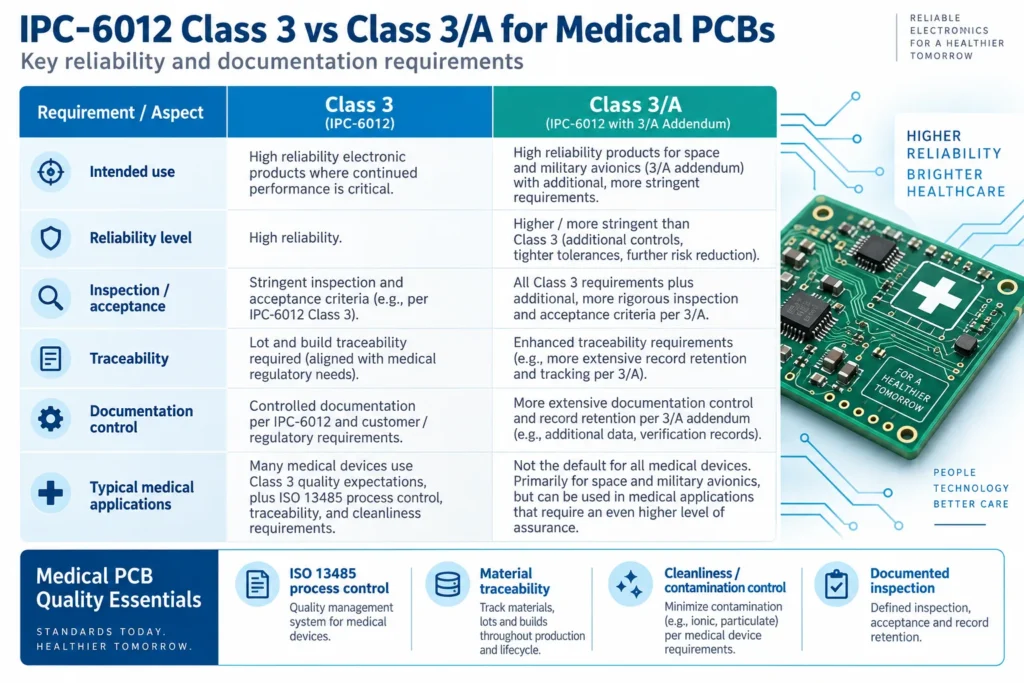
IPC-6012 Class 3 vs Class 3/A
IPC-6012 specifies qualification and performance requirements for rigid bare boards. It does not cover every aspect of an assembled medical device. Soldered assemblies have separate requirements, including those addressed by J-STD-001 and IPC-A-610.
IPC Class 3 applies where reliable performance is critical and downtime cannot be tolerated. However, IPC’s general printed-board specification places class selection with the user, based on end use. A medical application alone does not select the class.
“Class 3/A” appears in historical space and military avionics guidance. It is not a medical-specific class. The current IPC-6012FS addendum addresses that aerospace sector and works with IPC-6012F. Do not use “Class 3/A” as shorthand for medical suitability.
| Class | Application | Tolerance | Inspection Level |
|---|---|---|---|
| Class 1 | General electronics where basic function is the main requirement. | Relevant Class 1 criteria and drawing requirements. | Tests and sampling specified for the selected standard and order. |
| Class 2 | Extended service life; uninterrupted service is desirable. | Relevant Class 2 criteria and drawing requirements. | Agreed conformance checks and records; no universal inspection percentage. |
| Class 3 | High-reliability service where continued or on-demand performance is critical. | Relevant Class 3 criteria; not automatically tighter in every dimension. | Applicable Class 3 inspection and test requirements, plus agreed additions. |
| Class 3/A terminology | Historical space and military avionics context, not a medical class. | Identify the exact base standard and supplemental requirements. | Follow the specified addendum and contract; do not infer a medical test plan. |
This is a selection guide, not an acceptance table. Exact limits and sampling belong in the applicable standard and purchase specification. IPC classes also differ from regulatory medical-device classifications.
For medical rigid boards, IPC-6012EM is the medical applications addendum to IPC-6012E. Specify matching editions. Do not automatically combine it with the newer F base edition. Resolve any revision differences before ordering. Our guide to IPC compliance standards explains the wider division between fabrication and assembly requirements.
ISO 13485 and Its Impact on PCB Manufacturing
ISO 13485:2016 sets quality management system requirements for medical-device organizations. It can also apply to suppliers. It concerns controlled processes and records, not a certificate for each individual circuit board.
For procurement, the practical questions are specific. Who approves the drawing? How are suppliers assessed? What happens when a material changes? How are nonconforming boards contained? Which records demonstrate that the released lot meets the order?
When certification is required, check the named company, manufacturing site, scope, validity, and issuing body. A certificate covering one site or activity does not automatically cover every operation. ISO 9001 certification does not establish ISO 13485 certification or approval for implantable products.
Review Benlida’s published PCB quality control information, then request current evidence relevant to your project. Confirm the applicable quality agreement before production. The device manufacturer’s quality team should approve the supplier and final requirements.
Material Traceability Requirements for Medical Boards
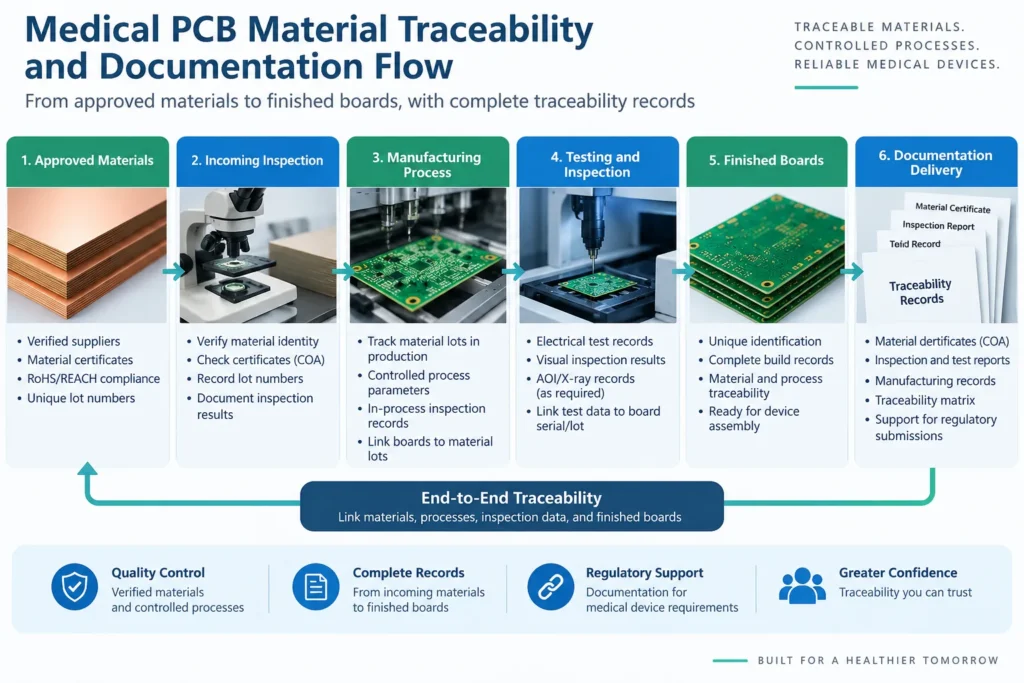
Traceability connects a delivered board lot to the materials, production records, and acceptance evidence behind it. Define the required depth before quotation. “Full traceability” is too vague unless both parties agree on what can be traced and how long records remain available.
A useful purchase specification can request:
- Board part number, approved revision, purchase order, and manufacturing lot.
- Laminate and prepreg identification, supplier, and batch information.
- Relevant solder mask, finish, and other controlled material records.
- Inspection and test reports linked to the supplied lot.
- Approved deviations, rework records, and material or process changes.
- Agreed record retention, retrieval time, and identification method.
These are procurement examples, not a universal list for every device. The FDA’s MDSAP audit approach addresses additional traceability considerations for implantable and life-supporting devices. Ask the device quality team which material, component, process, and personnel records must be retained.
Lot-level identification may suit some projects. Others need individual board identifiers. Agree on marking location and readability without reducing insulation distances or damaging the board. For PCBA orders, component lots and assembly records form an additional traceability chain.
Before approval, request a sample record package. Check whether a delivered lot identifier can retrieve the related material and inspection records. A certificate of conformity alone may not contain the detail your quality agreement requires.
Cleanliness and Contamination Control
Residues, particles, and moisture can affect circuit reliability. Bare-board fabrication and assembly introduce different contamination risks. Flux residue is an assembly concern, while fabrication also needs controls over processing chemicals, rinsing, handling, and packaging.
Visual inspection cannot establish electrical cleanliness on its own. Ionic analysis and surface insulation resistance testing answer different questions. IPC’s discussion of residues and coating reliability explains how contamination, moisture, and electrical bias can interact. Select evidence that represents the actual materials and operating conditions.
Define the cleaning process, test method, acceptance limits, and sampling plan in the order. Also define when testing occurs, who reviews the result, and what triggers requalification. Do not apply a single ionic-contamination limit to every medical board without checking the specification.
Coating is not a substitute for controlling contamination. Verify compatibility among residues, cleaning chemistry, coatings, and board materials. Consider inaccessible areas beneath low-clearance components during assembly process review.
Electrical cleanliness and sterility are separate issues. A clean PCB does not validate a medical device’s sterilization process. Where cleaning, disinfection, or sterilization affects the device, assess the materials and finished assembly under the intended process.
Common Medical PCB Applications
Diagnostic and therapeutic equipment
Imaging systems, laboratory instruments, and treatment equipment may combine sensitive signals with power electronics. Review isolation, grounding, signal integrity, thermal behavior, and fault conditions. The required controls depend on what the circuit does and how it connects to the user or patient.
IEC 60601-1 addresses basic safety and essential performance of medical electrical equipment. It is not a standalone PCB certificate. Applicable equipment-specific standards can add requirements. Set insulation distances from the actual design conditions rather than copying a generic spacing value.
Wearable monitoring devices
Wearables may face sweat, moisture, repeated movement, and battery constraints. Distinguish the skin-contacting enclosure from the internal circuit board. Review connectors, flex areas, seals, and cleaning exposure. A small board is not automatically a low-risk board.
Implantable devices
Implantable PCB standards form only part of the device requirements. Long-term reliability, packaging integrity, material compatibility, and traceability need specialist review. Do not infer suitability from a substrate name or an IPC class alone.
The FDA’s biocompatibility guidance evaluates the device in its final finished form, considering body contact and processing. A laminate data sheet cannot establish the biological safety of the complete device. These application examples do not imply that any particular supplier is qualified for implantable production.
Across these applications, arrange an engineering design review before releasing files. Share the use environment, standards, critical features, and required evidence. Keep device-level verification responsibilities separate from the supplier’s board acceptance checks.
FAQ
What is IPC-6012 Class 3/A?
Class 3/A is terminology found in older space and military avionics requirements. It is not a universal medical PCB class. For a medical order, identify the exact IPC base standard, performance class, and applicable medical addendum instead of relying on that label.
Does Benlida manufacture to medical-grade standards?
“Medical-grade” is not a single manufacturing standard. Ask Benlida to confirm your exact IPC requirements, current certification scope, traceability records, and cleanliness criteria in writing. Medical project acceptance must be based on that evidence, not a general capability statement.
What traceability documentation is required for medical PCBs?
The required records depend on the device, applicable requirements, and quality agreement. Common requests include revision control, material batches, manufacturing lots, inspection reports, and approved changes. Define retention and retrieval requirements, with deeper traceability where the device risk requires it.
Are ceramic or FR-4 boards better for medical applications?
Neither is automatically better or medically approved. Compare the exact material grade against thermal, electrical, mechanical, processing, and lifetime requirements. Assess body-contact and sterilization conditions where relevant. The substrate alone does not establish safety or suitability for implantation.
Building a Medical Device PCB
Send Benlida your Gerber or ODB++ files, fabrication drawing, stackup, revision, and quantity. Include the required standard editions, IPC class, cleanliness criteria, and traceability records. For assembly, add the BOM, placement files, and test requirements.
Request confirmation of project feasibility and the required evidence before placing the order. Resolve any certification, material, or documentation gaps with your engineering and quality teams before production.