

PCB Assembly Inspection Levels — AQL, IPC, and 100% Test
What Are PCB Assembly Inspection Levels?
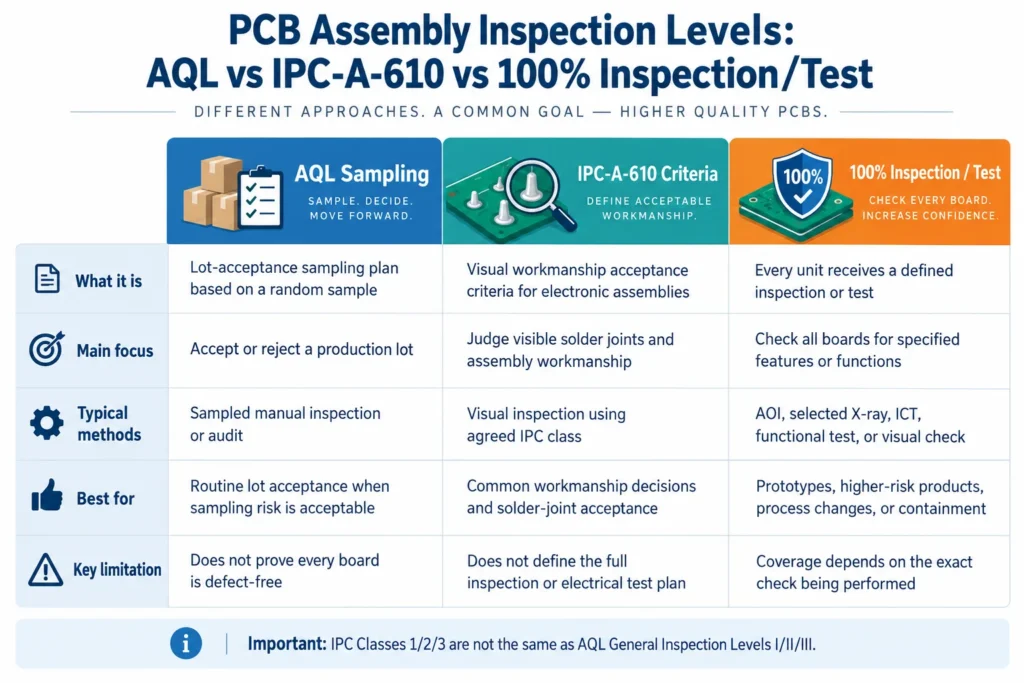
PCB assembly inspection can check a sample of a production lot or every assembled board. AQL sampling supports lot-acceptance decisions. IPC-A-610 provides visual acceptance criteria. A 100% check covers every unit for a defined inspection or test. These describe different parts of a quality plan.
A PCB is a bare board. A PCBA has components installed. Here, the focus is assembly quality, including component placement, solder connections, and specified electrical behavior.
Before comparing inspection options, ask three questions:
- Which assemblies and features will be checked?
- What criteria define an acceptable result?
- Which method can detect the relevant problem?
For example, inspecting every board optically does not prove that every hidden joint is sound. Likewise, a passing functional test does not establish that every visible solder connection meets its workmanship requirements.
AQL Sampling Standards Explained
AQL means Acceptance Quality Limit. It is used to select an acceptance sampling plan. The plan supports a decision about a lot based on a randomly selected sample.
ASQ describes ANSI/ASQ Z1.4 as an attribute-sampling system for a continuing stream of lots. Attribute inspection classifies results, such as conforming or nonconforming, rather than relying on a measured-value distribution. The system includes normal, tightened, and reduced inspection plans with switching rules.
ISO 2859-1 is another AQL-indexed framework for lot-by-lot attribute inspection. Specify the standard and edition in the quality agreement. Do not combine tables or rules from different editions without review.
To define AQL sampling for PCB assembly, agree on:
- The lot boundary, product revision, and unit being counted.
- The defect categories and whether the plan counts nonconforming units or individual nonconformities.
- The inspection level, AQL values, sampling method, and applicable inspection state.
- The sample selection method, acceptance and rejection limits, and action after a rejected lot.
Lot size and inspection level first identify a sample-size code letter. The selected plan, AQL, inspection state, and table instructions determine the actual sample size and decision limits. ASQ’s sample-size explanation shows why table arrows must also be followed.
General Inspection Levels I, II, and III are not the same as normal, tightened, and reduced inspection. Follow the specified switching rules. One passing lot is not, by itself, permission to reduce inspection.
AQL is not a fixed allowance for defective boards in every shipment. NIST’s acceptance-sampling overview explains the risks of accepting poor lots or rejecting good ones. Even a plan with zero allowed failures in the sample cannot prove that uninspected units are defect-free.
Before inspection, agree on how a rejected lot will be handled. The plan may call for investigation, sorting, rework, or authorized resubmission. Do not keep drawing fresh samples until one happens to pass. Follow the documented disposition process and preserve the original results. This avoids turning an acceptance plan into a series of unrecorded attempts.
IPC-A-610 Acceptance Criteria for Solder Joints
IPC-A-610 covers visual acceptance of electronic assemblies. It addresses soldering and other workmanship features. Apply the relevant criteria to the actual connection type and agreed product class. A single photograph or generic solder-joint rule cannot replace the applicable requirements.
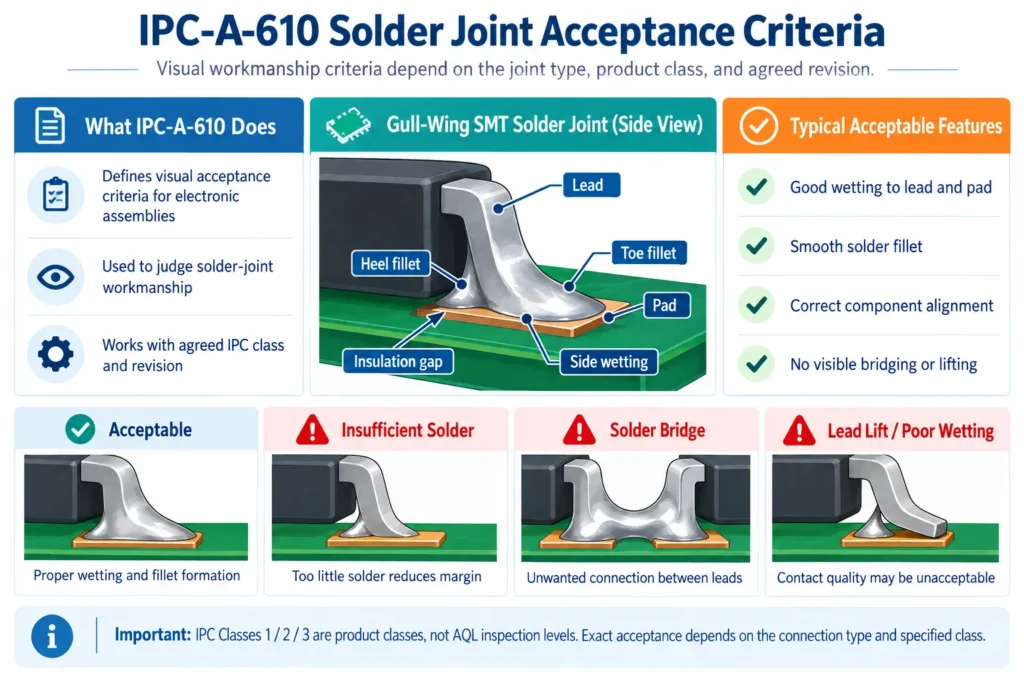
IPC Classes 1, 2, and 3 reflect different product performance needs. They are not AQL General Inspection Levels I, II, and III. Writing “Class 2” on an order does not define the full inspection and test plan.
J-STD-001 addresses soldering materials, processes, and acceptance requirements. It complements IPC-A-610. Agree on the applicable revisions, class, customer requirements, and any required addenda before production.
IPC-A-610J explicitly excludes X-ray and cross-section evaluation criteria from its scope. It points to J-STD-001 for X-ray guidance. Specify hidden-joint evaluation and electrical tests separately. A visual acceptance result alone does not establish circuit function or long-term reliability.
When 100% Inspection Is Required
A 100% inspection requirement applies when the agreed specification, control plan, or applicable product requirement calls for every unit to receive a defined check. Neither a prototype label nor a safety-critical application, alone, defines the full scope.
Checking every unit for selected features can be useful during prototype builds, process changes, or defect containment. Higher-consequence failures may justify additional checks. Engineering and quality teams should decide which checks address those risks and document any mandatory requirements.
Define “100%” precisely. Does it mean every board receives AOI? Every BGA location receives X-ray review? Every assembly completes a named functional test sequence? These are different commitments.
Also record the program revision, limits, excluded features, and evidence retained. A test can run on every unit while still missing faults outside its coverage. A passing result is not a zero-defect guarantee.
How Inspection Level Affects Cost and Lead Time
For the same check, sampling usually requires fewer unit-level checks than full inspection. Total cost also includes programming, fixtures, handling, result review, and investigation of failures. A short automated check on every board may cost less than a lengthy manual sample review.
The comparison below describes planning options. Relative costs depend on the board and test scope; they are not Benlida prices.
Inspection Level Comparison
| Inspection Type | Coverage | Best For | Relative Cost |
|---|---|---|---|
| AQL lot-acceptance sampling | Random sample with defined decision limits | Agreed lot acceptance where sampling risk is acceptable | Usually less inspection effort than checking every unit for the same features |
| 100% visual or AOI inspection | Every assembly; specified visible features only | Repeatable checks for placement and visible workmanship | Setup plus per-board inspection and review |
| 100% specified X-ray inspection | Defined hidden-joint locations on every assembly | Projects requiring all-unit checks of selected hidden joints | Depends strongly on image detail, locations, and review time |
| 100% specified electrical or functional test | Every assembly; defined nodes, functions, and limits | Finding targeted electrical faults or verifying operating behavior | Program and fixture cost plus test-cycle time |
These options can coexist. A production plan might combine all-unit AOI with a separate sampled final audit. Neither replaces the other automatically.
Confirm lead time after the test scope is clear. New fixtures, programming, and failure analysis can affect the schedule. Define who approves repairs, retests, and lot release so a failed check has a clear next step.
When comparing quotations, check whether both suppliers include the same inspection work and reporting. One quote may cover selected X-ray locations on sampled assemblies. Another may cover every specified location on every assembly. Ask about setup charges, repeat-build costs, and report delivery. A lower price is difficult to evaluate when the coverage differs.
Combining AOI, X-Ray, and Manual Inspection
Choose methods by the defects they can reveal. Automated optical inspection, or AOI, checks camera-visible assembly features. Component presence, orientation, and visible solder conditions depend on the program and viewing access. Our guide to AOI testing in PCB assembly explains those limits.
X-ray supports inspection beneath packages where optical access is blocked. Omron’s technical discussion of CT inspection explains hidden-joint challenges and differences between transmission images and CT. The chosen technique still needs suitable resolution and acceptance criteria. Read more about X-ray inspection for hidden joints.
Manual inspection can review accessible features, unusual assemblies, and machine-flagged conditions. Inspectors need clear criteria and suitable viewing conditions. Manual review cannot see through a package or confirm electrical operation simply from appearance.
Electrical testing adds different evidence. Keysight’s ICT guidance distinguishes component-level fault checks from complementary functional testing. ICT depends on accessible nodes and the test program. Functional testing checks specified behavior under defined power, inputs, loads, and firmware.
For each check, record the target defect, method, unit coverage, pass/fail limit, and retained result. Keep bare-board electrical test records separate from PCBA inspection and functional results. This makes gaps easier to identify before quoting.
Request a sample report format before the order. Decide whether results must be linked to a lot or individual serial number. Include how repaired assemblies and retest outcomes will be identified.
FAQ
What is AQL sampling in PCB assembly?
It is a lot-acceptance method that checks a random sample against agreed criteria and decision limits. AQL helps select the plan. Passing the sample does not mean every assembly in the lot is defect-free.
Does Benlida offer 100% inspection for prototype orders?
Request written confirmation for your specific prototype. State whether you need all-unit visual inspection, AOI, selected X-ray checks, electrical testing, or functional testing. The agreed quote and quality plan should identify the coverage, limits, and records supplied.
What is IPC-A-610 and why does it matter?
IPC-A-610 provides visual acceptance criteria for electronic assemblies. It gives buyers and suppliers a common basis for workmanship decisions. Specify the revision and class, then document the required inspection methods and tests.
Which inspection level is standard for production orders?
No single plan fits every production order. Agree on the product class, sampling requirements, all-unit checks, and electrical tests. Base the scope on product risk, process history, customer requirements, and applicable rules.
Need Assurance on Assembly Quality?
Review Benlida’s quality control and assurance services, then send your BOM, placement file, assembly drawing, revision, and quantity. Include the required acceptance standard and test specification. Ask Benlida to confirm the proposed methods, coverage, records, cost, and lead time before ordering.