

PCB Surface Finish Types: HASL, ENIG, OSP, and Immersion Silver
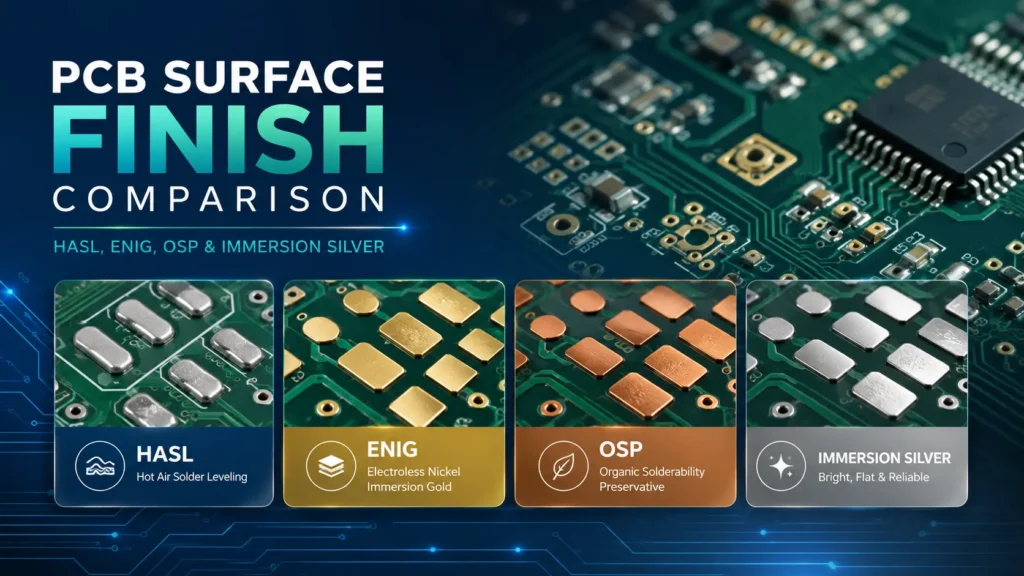
A PCB surface finish protects exposed copper before assembly. It also provides a controlled surface for soldering. Four widely used options are HASL, ENIG, OSP, and immersion silver. Each balances cost, flatness, storage sensitivity, and process risk differently.
There is no single best finish. Lead-free HASL is practical for many general boards. ENIG provides flat pads. OSP is thin and cost-conscious but handling-sensitive. Immersion silver is flat and solderable but needs tarnish control. Choose against the board and assembly process.
What Is a PCB Surface Finish?
Solder resist covers most of the external circuit pattern. A surface finish coats the copper that remains exposed at pads and other specified features. See our PCB solder resist guide for a closer look at that distinction.
The finish preserves solderability between fabrication and assembly. It can also affect pad coplanarity, inspection, probing, contacts, wire bonding, rework, and storage. Qualify it for the exact function, material set, and assembly profile.
HASL: Process, Benefits, and Limits
HASL means hot air solder leveling. Molten solder coats the exposed copper. Hot air removes the excess and clears the holes. This creates a durable, familiar solderable coating.
HASL is available in traditional tin-lead and lead-free versions. State the alloy on the drawing. For a RoHS build, specify lead-free HASL and obtain a material declaration. Tin-lead HASL normally needs a valid exemption.
The main tradeoff is planarity. Solder thickness varies, so HASL is usually less flat than ENIG, OSP, or immersion silver. It is not universally incompatible with fine pitch. Still, BGAs, QFNs, small passives, and tight coplanarity need an early review.
When HASL Is a Practical Choice
Lead-free HASL can suit general boards, through-hole assemblies, larger-pitch SMT, and cost-sensitive builds. Confirm the alloy, pad geometry, thermal exposure, and finished-thickness controls.
ENIG: Flatness, Fine-Pitch Use, and Process Risks
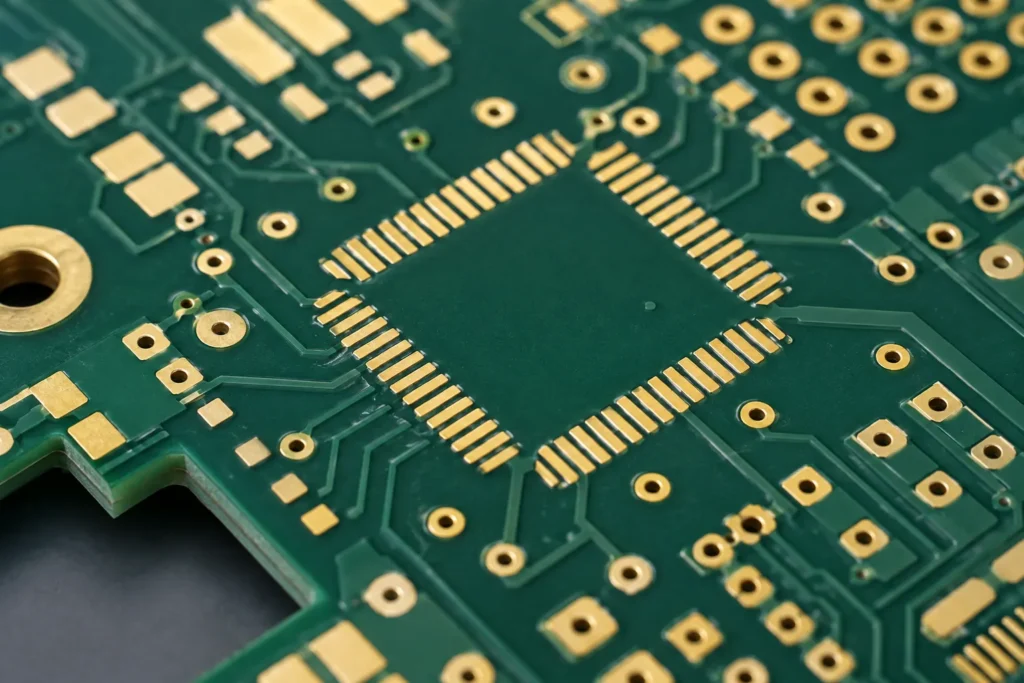
ENIG means electroless nickel immersion gold. The process deposits an electroless nickel layer over copper. A thin immersion-gold layer then protects the nickel before soldering. The nickel acts as a barrier layer, while the gold helps preserve the surface.
ENIG creates a flat pad. It is a common candidate for BGA, QFN, and fine-pitch SMT. Selected contact or wire-bonding uses need separate qualification. Standard ENIG is not a substitute for wear-resistant hard gold on repeatedly mated contacts.
ENIG usually costs more than HASL or OSP. It adds controlled chemical deposition and precious metal. Abnormal nickel corrosion can contribute to the failure mode called black pad and create a brittle interface. This is a process risk, not an inevitable ENIG defect.
The current IPC-4552B ENIG specification addresses deposits, tests, and process control. Purchase documents should name the revision and project criteria. The supplier should control bath chemistry, thickness, and nickel corrosion.
When ENIG Is a Practical Choice
ENIG often suits dense SMT, BGA areas, mixed pitches, and boards that need flat pads. Verify the thickness, soldering profile, storage, and any contact or bonding function.
OSP: Cost, Flatness, and Handling Limits
OSP means organic solderability preservative. It forms a very thin organic film on exposed copper. The coating protects the copper during storage and is displaced during soldering. Because it adds little height, OSP leaves the underlying pads very flat.
OSP is often a lower-cost option. It works well for fine-pitch assembly when boards are fresh, clean, and correctly handled. This can suit high-volume products with a controlled fabrication-to-assembly schedule.
The tradeoff is sensitivity. Finger contact, contamination, open packaging, humidity, and thermal cycles can reduce the soldering window. Qualified high-temperature OSP can support multiple heat cycles, but the approved count is product-specific. It can also be harder to inspect than a metallic finish.
There is no universal OSP shelf life. Supplier claims apply to a named chemistry under stated conditions. Follow the date code, sealed-packaging instructions, storage limits, and assembly window.
When OSP Is a Practical Choice
OSP suits cost-sensitive, fine-pitch boards that move quickly into controlled assembly. It is less attractive with uncertain storage, frequent handling, many heat cycles, or repeated rework.
Immersion Silver: Solderability and Tarnish Control
Immersion silver deposits a thin silver layer on exposed copper through a displacement reaction. It is flat and solderable when clean and properly stored. This suits fine-pitch assembly. Electrical or contact uses still need project-specific qualification.
The main concern is environmental sensitivity. Silver can tarnish after exposure to sulfur, chlorine, moisture, or poor handling. Severe corrosion may affect soldering or field reliability. Barrier packaging, gloves, cleanliness, humidity, and storage time all matter.
Its cost is often described as between OSP and ENIG, but this is not universal. Chemistry, volume, packaging, and inspection change the quote. Use project pricing.
When Immersion Silver Is a Practical Choice
Immersion silver can suit fine-pitch SMT and designs that need a flat, thin metallic finish. For high-frequency work, include the finish in the electrical model. Use barrier packaging and controlled storage.
HASL vs ENIG vs OSP vs Immersion Silver
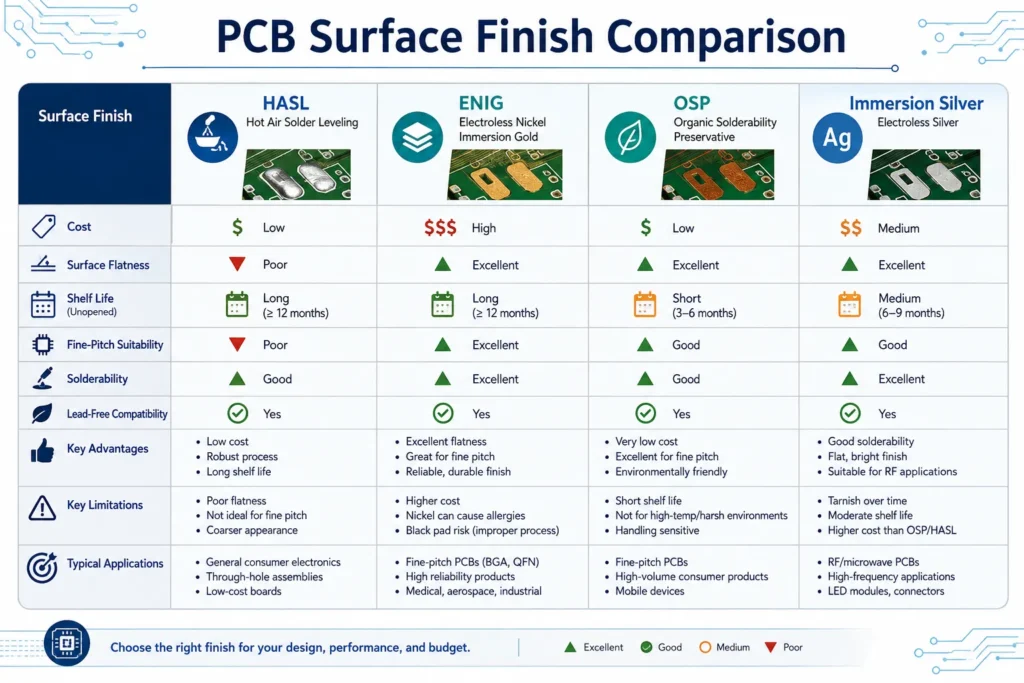
This table is planning guidance, not a supplier guarantee. Cost and storage performance vary with chemistry, volume, packaging, environment, contamination, and thermal history.
PCB surface finish comparison for early design selection
| Finish | Relative Cost | Shelf Life and Handling | Flatness | Solderability | RoHS Note | Best Fit | Main Tradeoff |
|---|---|---|---|---|---|---|---|
| Traditional tin-lead HASL | Usually lower | Often robust, but supplier conditions still apply | Lower | Strong when the alloy and assembly profile are qualified | Contains lead; only use where the compliance basis permits it | Legacy or exempt applications with larger pads and through holes | Lead content and uneven pad height |
| Lead-free HASL | Usually lower | Often robust, but verify packaging and storage limits | Lower | Strong when the alloy and assembly profile are matched | Can support a compliant build; verify the full material declaration | General boards, through-hole, and larger-pitch SMT | Pad planarity and higher process temperature |
| ENIG | Usually higher | Often suitable for planned storage; exact window is supplier-specific | Excellent | Good when deposits and assembly are controlled | Can support a compliant build; verify declarations | BGA, QFN, fine-pitch SMT, and selected contact uses | Higher cost and nickel-corrosion risk if the process is poorly controlled |
| OSP | Usually lower | More sensitive to handling, open packaging, storage, and thermal cycles | Excellent | Good on fresh, clean copper within the qualified process window | Can support a compliant build; verify the chemistry declaration | Cost-sensitive fine-pitch boards with a controlled assembly schedule | Handling, inspection, rework, and storage sensitivity |
| Immersion silver | Project-dependent; often below ENIG | Needs clean handling and protection from sulfur and moisture | Excellent | Good when clean and properly stored | Can support a compliant build; verify declarations | Fine-pitch SMT and selected thin-finish electrical applications | Tarnish, corrosion, packaging, and handling sensitivity |
How to Choose the Right PCB Surface Finish
Start With Component Pitch and Pad Flatness
Review the smallest passive, BGA pitch, QFN pad, connector, and test point. Flat finishes can improve consistency on small pads. HASL may still work when its finished geometry meets the assembly requirement. Ask the fabricator and assembler to review the same data.
Map the Complete Assembly Process
Count every thermal exposure. Include double-sided reflow, selective or wave soldering, rework, and later integration. Check alloy compatibility and peak temperature. Benlida’s PCB assembly services page gives context for aligning fabrication and assembly requirements.
Define Storage, Packaging, and Handling
Record the time between fabrication and assembly. Include shipping climate, warehouse control, package-opening rules, and partial-lot storage. OSP and immersion silver need clear handling controls. Avoid shelf-life promises without named conditions.
Check Compliance and End-Use Functions
The European Commission’s RoHS overview explains its restricted substances. A finish name does not prove compliance. Obtain material declarations, and identify any exemption or market-specific requirement.
Define non-soldering functions too. Examples include edge contacts, membrane switches, test probing, wire bonding, press-fit connections, and high-frequency performance. Good solderability does not qualify every use.
Put the Requirement in the Fabrication Package
State the finish on the fabrication drawing and purchase order. Add thickness, specification, revision, contact area, packaging, and test requirements when needed. Check IPC’s current document revision table. It lists IPC-4552B for ENIG and identifies IPC-4553A for immersion silver as no longer maintained. The customer and supplier should agree on the current contract requirement.
Inspection should match the risk. Appearance alone cannot prove thickness or interface quality. Agree on records, sampling, measurements, solderability checks, or coupons. Benlida’s PCB quality control page gives broader context. Project-specific acceptance still needs written agreement.
PCB Surface Finish FAQ
What Is the Shelf Life of OSP Surface Finish?
There is no single shelf life for every OSP board. The usable window depends on the named OSP chemistry, packaging, storage temperature and humidity, handling, contamination, and prior thermal cycles. Follow the fabricator's documented expiration and storage instructions. Ask for reassessment after damaged packaging or extended storage.
Why Does ENIG Have a Risk of Black Pad Defects?
Black pad is linked to abnormal corrosion of the electroless nickel during the finish process. A severely affected interface can become brittle and weaken a solder joint. It is not an unavoidable result of using ENIG. Controlled chemistry, deposit requirements, process monitoring, and suitable acceptance testing reduce the risk.
Is HASL Compatible With Fine-Pitch Components?
Sometimes. HASL is less planar than ENIG, OSP, or immersion silver, so pad-height variation may challenge very small components and tight-pitch packages. Compatibility depends on pad size, pitch, paste printing, placement, and the supplier's finished coating. Review the smallest features before selecting it.
Which Surface Finish Is Best for RoHS Compliance?
No single finish is automatically best for RoHS. Lead-free HASL, ENIG, OSP, and immersion silver can be part of a compliant board when the full material set meets the applicable limits. Traditional tin-lead HASL normally needs a valid exemption. Verify supplier declarations instead of relying on the finish name.
Need Help Choosing a PCB Surface Finish?
Benlida’s public PCB pages list HASL, lead-free HASL, ENIG, OSP, and immersion silver. Availability and limits depend on the board and production route. Share your Gerber or ODB++ data, component pitch, assembly process, storage needs, compliance requirements, quantity, and target cost. Ask Benlida to review the build and confirm project options.
For fabrication, include the layer count, material, thickness, copper, impedance, revision, and tests. For PCBA, add the BOM, centroid file, assembly drawing, solder alloy, reflow limits, and test requirements.