

Box Build Assembly — What It Is and When You Need It
What Is Box Build Assembly?
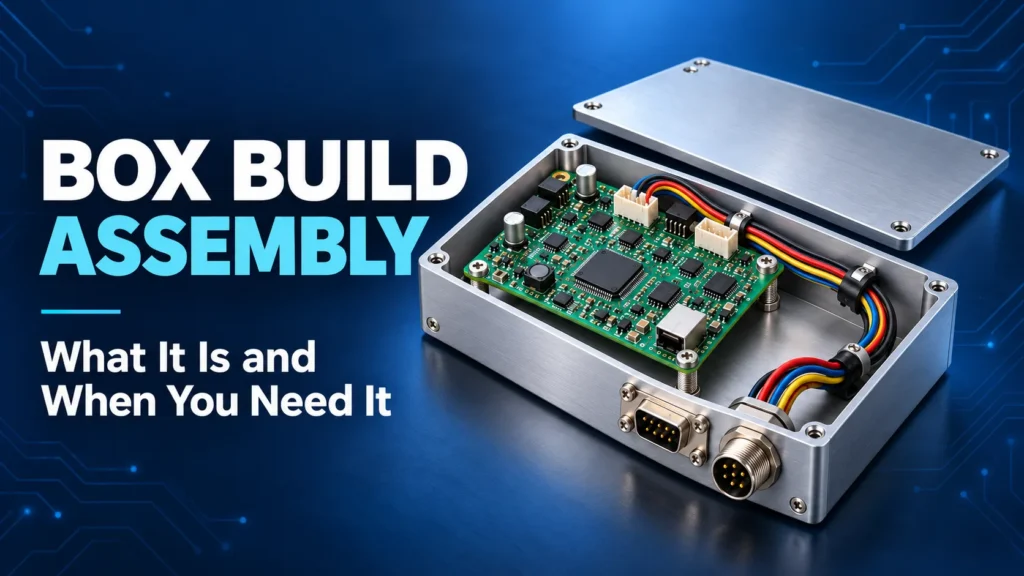
Box build assembly combines assembled circuit boards with an enclosure, wiring, cables, and mechanical parts. It turns separate assemblies into an integrated unit, with testing defined for that product. It makes sense when you need a supplier to manage the mechanical and electrical integration that would otherwise happen in-house or across several vendors.
The result may be a finished product or a subsystem ready for installation. The order must define that endpoint. Enclosure sourcing, firmware loading, packaging, and certification work are not automatically included.
A PCB is a bare circuit board. A PCBA is a board with components installed. Box build adds integration around one or more PCBAs. This box build assembly guide explains what to specify before requesting a quote, so you can compare offers against the same deliverable.
Box Build vs Standard PCBA — Key Differences
Standard PCB assembly focuses on the populated board. Box build extends the scope to the surrounding product. The key question is where the supplier’s responsibility ends: at a tested board, an integrated module, or a packed unit.
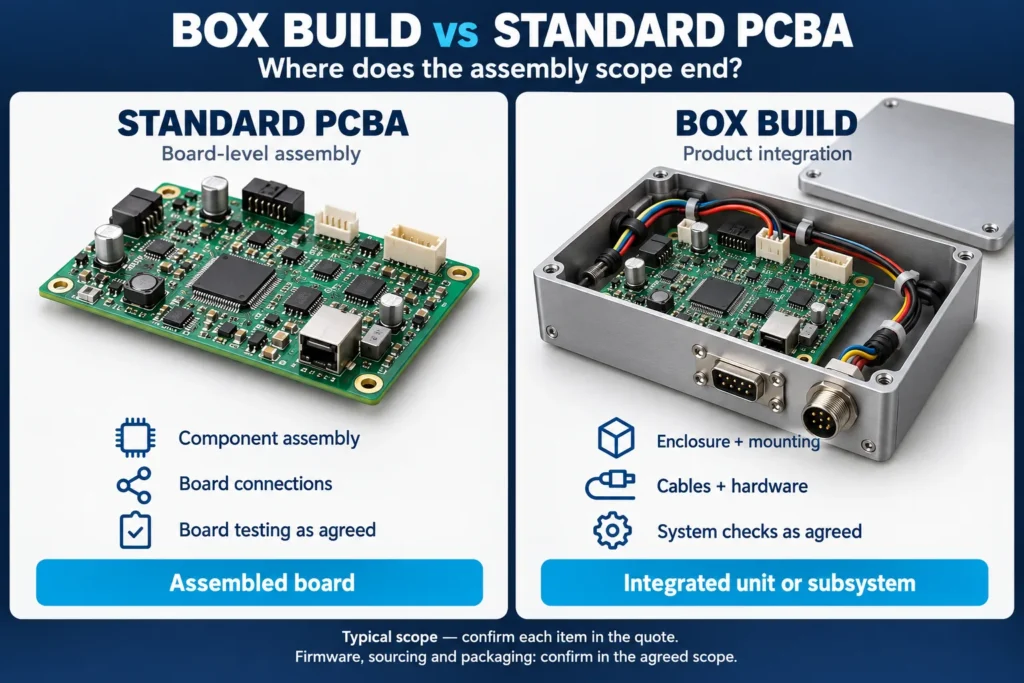
The table shows typical boundaries, not a fixed package offered by every manufacturer. Confirm each item in the quote.
Box Build vs Standard PCBA
| Scope Item | Standard PCBA | Box Build |
|---|---|---|
| Component assembly | Components installed on the PCB | PCBAs incorporated into a larger unit |
| Enclosure and mounting | Usually outside the board-only scope | Board and hardware installation as specified |
| Cables and wiring | Board connections or leads if ordered | Internal harness routing and interconnection as specified |
| Firmware and configuration | Available only when agreed | Product configuration and version checks when agreed |
| Inspection and testing | Agreed board-level checks | Agreed board, integration, and system checks |
| Labels and packaging | Board identification and protective packing | Unit labeling, accessories, and packing when ordered |
| Purchasing responsibility | Depends on the sourcing model | Must cover each electronic and mechanical item explicitly |
Turnkey sourcing and box build describe different decisions. Turnkey identifies who purchases the agreed materials; box build identifies the assembly scope. A turnkey PCBA order can still end with an assembled board. For purchasing comparisons, see our discussion of turnkey vs partial PCB assembly.
What's Included in a Box Build Order
Start with a system bill of materials, or BOM. Include the PCBAs, enclosure, cables, connectors, fasteners, labels, and accessories. List manufacturer part numbers or controlled drawings, quantities, and revisions. Small items such as spacers and washers still need clear specifications.
Mechanical instructions should show board supports, mounting holes, connector openings, and the assembly sequence. Specify fastening requirements from the approved design or part documentation. Avoid a single generic torque value for different screws, materials, and joints.
Wiring instructions should identify endpoints, pin assignments, lengths, routing, and strain relief. A correct electrical connection can still be unreliable if a cable pulls on its terminal. Molex’s connector retention guidance distinguishes connector locking from terminal retention and explains the role of strain relief. Check seating and locks against the exact connector documentation.
If your project uses custom cables, discuss wire harness assembly alongside the enclosure layout. Leave access for installation and servicing. Check that closing the cover does not trap wires or strain a connector.
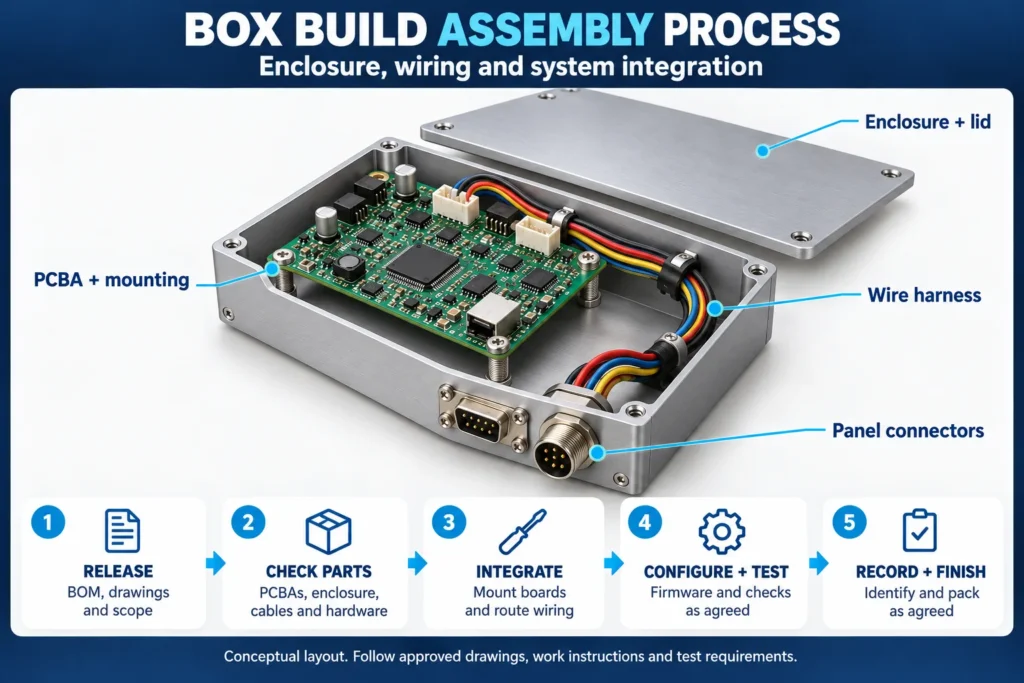
A practical box build manufacturing process moves through these stages:
- Release the drawings, BOM, sourcing responsibilities, and acceptance plan.
- Receive and check the required boards, cables, and mechanical parts.
- Assemble and inspect the unit using controlled work instructions.
- Load approved firmware and run the specified tests, where included.
- Record results, identify the unit, and pack the agreed deliverables.
When Box Build Makes Sense for Your Product
Box build is worth considering when the enclosure and interconnections are a substantial part of the product. It can also suit a team that wants to outsource repeatable assembly work but retain product design authority.
Consider a hypothetical industrial gateway. Its PCBA may pass a bench test, yet the product still needs a housing, panel connectors, a power cable, and configuration. Someone must confirm that these parts fit and work together. An integrated order can assign that work to one supplier, provided the responsibilities are written down.
Board-only assembly may be more practical while the enclosure changes frequently or your team is still experimenting with cable routing. It can also fit a product installed directly into a machine that you assemble yourself. A small batch alone does not determine which model is better.
Before committing, assess design stability, internal assembly resources, service needs, and the proposed test plan. Review Benlida’s box build assembly services and request confirmation of the scope for your specific product.
Testing and Quality Control at the System Level
A passing PCBA result does not prove that the integrated unit works. Final assembly adds connections, mechanical interfaces, and configuration steps. A misplaced cable or incorrect firmware version can create a problem after board testing.
Separate workmanship inspection from functional testing. Inspection can check cable routing, fasteners, connector engagement, labeling, and visible damage. Functional testing checks defined product behavior under specified conditions.
For cable workmanship, IPC/WHMA-A-620 covers cable and wire harness assemblies. Agree on the applicable revision, class, and inspection plan. Naming the standard alone does not define inspection frequency or establish that the complete product functions correctly.
The test specification should list operating conditions, connections, loads, test steps, and pass/fail limits. NI’s production-test guidance describes functional testing against predefined specifications. It also identifies coverage, cycle time, and accessible test data as planning requirements.
Depending on the product, checks may cover startup, communication ports, switches, indicators, or sensor inputs. Specify firmware verification and calibration separately where needed. Define any electrical safety testing with qualified engineering input; do not apply generic test settings to every unit.
Decide which checks occur on each unit and which belong to qualification or sampling. Record the serial number, hardware revision, firmware version, and required test results. Define how failed units are isolated, corrected, and retested.
Routine production checks are not a substitute for product certification. UL explains that component recognition is not certification of a complete product. Confirm any separate safety, EMC, or environmental evaluation responsibilities before production.
Sourcing and Lead Time Considerations for Box Build
Plan the schedule around the complete parts list. Finished PCBAs cannot become finished units while a custom enclosure, cable, or connector is missing. Check availability for the intended quantity before agreeing on the build date.
For each purchased item, assign responsibility for sourcing, approval, incoming checks, and shortages. Customer-supplied parts need an agreed delivery date and quantity. Define how incorrect or damaged parts will be handled.
An off-the-shelf enclosure may need machining, printing, or new mounting features. A custom enclosure may require tooling and sample approval. Include those steps in the schedule rather than treating the enclosure as a simple catalog purchase.
Separate one-time engineering, tooling, and fixture charges from recurring assembly and test costs. Compare the total cost of receiving an equivalent finished unit. Include your own purchasing, assembly, and inspection work when comparing box build with a board-only quote. Neither route is automatically cheaper.
Before requesting a firm schedule, prepare:
- PCB manufacturing files, board BOM, placement data, and assembly drawings if board fabrication or assembly is included.
- System BOM, enclosure drawings, cable pinouts, and approved part alternatives.
- Firmware, configuration instructions, test limits, and required result records.
- Quantities, revision, sample approval process, labeling, and packing requirements.
Agree when lead time starts and whether it is quoted in calendar or working days. Separate manufacturing time from transit. Include test-fixture readiness and first-unit approval as schedule dependencies. If a design changes, review affected parts, instructions, and tests before continuing.
FAQ
What is included in a box build order?
It usually covers integrating PCBAs with an enclosure, wiring, and mechanical hardware. The written scope determines sourcing, firmware, system testing, labels, accessories, and packaging. Specify whether you need a finished unit or a subsystem, and identify anything your team will complete.
Is box build more expensive than standard PCB assembly?
It includes more work and materials, so the quoted total may be higher. That does not establish which option has the lower total cost. Compare equivalent finished units, including your internal labor, sourcing, tooling, testing, and handling costs.
Does box build include enclosure sourcing?
It can, but this must be agreed. The buyer may supply the enclosure, select a standard part, or request a custom design. Confirm who approves drawings and samples, pays for tooling, and manages changes before placing the order.
What testing happens after box build assembly?
The approved test plan controls the scope. It may include workmanship inspection, startup, interface checks, firmware verification, and other product functions. Safety tests, calibration, and environmental checks require separate definition where applicable. A simple power-on check does not demonstrate every function.
Need a Complete Finished Product, Not Just a Board?
Send Benlida your PCBA files, system BOM, enclosure and cable drawings, quantities, and test requirements. Ask about box build capabilities for your project, including which integration, sourcing, and testing steps can be included in one order. Request confirmation of responsibilities and acceptance criteria before approving the build.