

PCB Assembly Cost Factors — What Drives PCBA Pricing
What Drives PCB Assembly Cost?
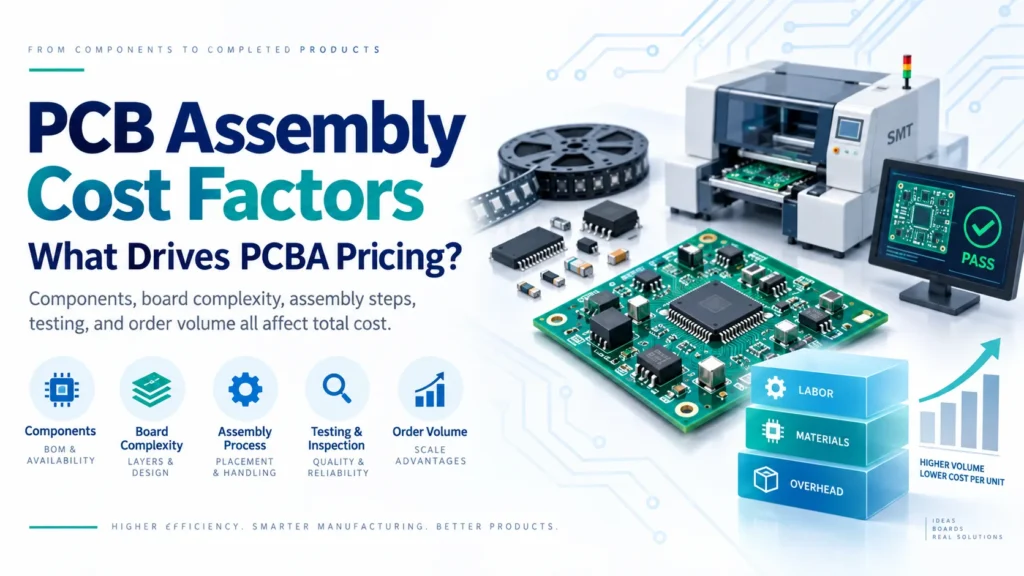
PCB assembly cost depends on component sourcing, board and assembly complexity, order volume, and testing requirements. Setup charges usually make prototypes more expensive per unit than repeat production. The largest cost driver varies by design. Turnkey assembly includes agreed sourcing responsibilities; partial turnkey divides them between buyer and assembler.
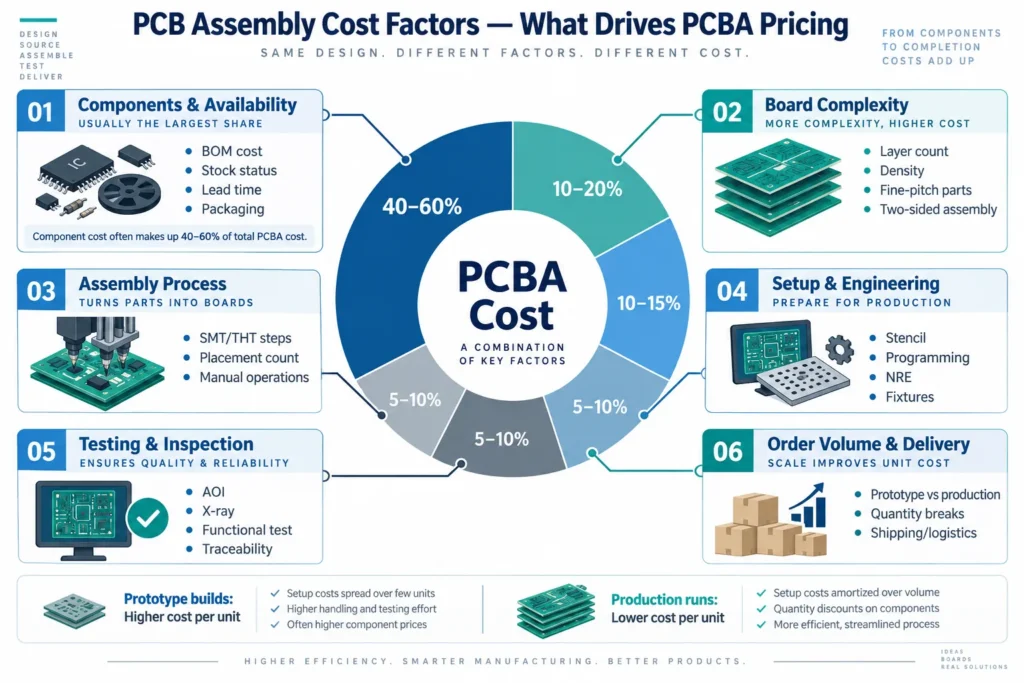
So, how much does PCB assembly cost? Start by checking what the quote includes. A bare PCB has no installed components. A PCBA is the assembled board. An assembly-only quote is not directly comparable with a quote that includes boards, components, and testing.
Separate one-time charges, such as stencils and test-fixture development, from recurring costs. Then check packaging, freight, duties, and taxes. These may sit outside the quoted unit price.
| Cost Factor | Impact on Price | Prototype vs Production |
|---|---|---|
| Components and availability | Part selection, stock, purchase quantities, and packaging affect material spend. | Small builds may miss price breaks. Larger builds need more confirmed stock. |
| Bare PCB construction | Layers, materials, dimensions, and fabrication features affect board cost. | Tooling and panel utilization influence unit cost at each quantity. |
| Assembly complexity | Placements, package types, board sides, and soldering steps affect processing effort. | Initial process setup may be reused, but assembly work remains. |
| Setup and engineering | Programming, stencils, fixtures, and first-build preparation add charges. | Costs are spread over fewer prototypes and more production units. |
| Inspection and testing | Coverage, equipment, cycle time, and reporting define the test scope. | Development can weigh heavily on prototypes; recurring test time matters at scale. |
| Schedule and delivery | Expediting, split shipments, and destination charges can increase total spend. | Neither prototype nor production volume removes schedule constraints. |
Component Sourcing and Availability
The bill of materials, or BOM, is the starting point for material pricing. Exact manufacturer part numbers matter. A generic description can hide differences in package, tolerance, temperature rating, or functionality.
Check stock against the entire build quantity, including agreed spares and process allowance. DigiKey distinguishes available stock, incoming stock, and manufacturer lead time. An estimated replenishment date is not stock ready to ship. Shortages may require a later build, approved substitutes, or a different purchasing plan.
Packaging also affects the order. Mouser’s packaging options include cut tape, full reels, and custom reels with a reeling fee. The right choice depends on the part and assembly process. Ask whether the quote covers minimum purchase quantities, extra components, and unused inventory.
Do not treat an unusually low price as proof of a better source. Texas Instruments warns about unauthorized-channel purchases, including counterfeit and storage-related risks. Confirm sourcing channels and traceability requirements before releasing an order.
Board Complexity — Layer Count, Density, and Fine-Pitch Components
Complexity affects both bare-board fabrication and assembly, but through different mechanisms. Layer count mainly affects the PCB fabrication line item. It does not directly set the price of placing each component.
For assembly, review component count, unique part types, package sizes, and access around each device. Fine-pitch parts can require tighter control of solder-paste printing and placement. NXP’s QFN/SON assembly guidance explains why small terminals and mixed package sizes need careful stencil design.
Components on both sides can add printing, placement, handling, and reflow steps. Through-hole connectors may need a separate soldering process. Shields, press-fit parts, or manual operations can add work that a simple placement count misses.
A smaller board is therefore not automatically cheaper. Dense layouts can make assembly, inspection, and rework harder. Ask for design-for-assembly feedback before fixing the layout and panel design.
Order Volume — Prototype vs Production Pricing
Prototype orders spread setup costs across a small number of boards. Stencils, machine programs, engineering preparation, and test development may be needed even for a short run. Separate these nonrecurring engineering charges, often called NRE, from the repeat-build unit price.
Higher quantities can spread setup costs and improve purchasing efficiency. However, savings are not automatic. A scarce component, a long test cycle, or a labor-intensive operation can still dominate production cost.
Request price breaks for realistic build quantities using the same revision and test scope. Ask which setup items are reusable and which charges apply again after a design change. Owning a fixture does not eliminate maintenance or revalidation costs.
Also compare total order spend. Buying excess inventory only to obtain a lower unit price may tie up cash or leave obsolete parts after a revision.
Testing and Inspection Requirements
“Tested” is not a complete specification. Define the defects or functions to check, the coverage, and the records required. These PCBA pricing factors affect setup effort and recurring time.
- AOI: Automated optical inspection checks visible assembly features, such as placement and accessible solder joints. It does not demonstrate circuit function.
- X-ray: This can reveal hidden solder-joint features. Viscom describes X-ray inspection of BGAs and solder voids where optical inspection has limits. Image acquisition and review depend on the agreed coverage.
- Functional testing: This powers the assembly and checks specified behavior under defined conditions. Fixtures, software, loads, interfaces, and pass/fail limits may need development.
Keysight’s cost-of-test guidance separates development and equipment considerations from ongoing operating costs. Apply that distinction when comparing test quotes. A custom fixture is different from the recurring time spent testing every board.
Confirm whether programming, calibration, failure analysis, retesting, and traceability reports are included. Do not remove required checks solely to reduce the quote. Agree on coverage with engineering and quality teams.
Turnkey vs Partial Assembly Cost Comparison
Turnkey assembly pricing can include bare boards, component purchasing, assembly, and agreed testing. The services may be bundled, but the quote can still show separate line items. Confirm the exact scope when reviewing turnkey PCB assembly services.
With partial turnkey, the buyer supplies selected components and the assembler sources the rest. With consigned assembly, the buyer supplies the component kit. Bare-board supply and testing arrangements still need explicit agreement.
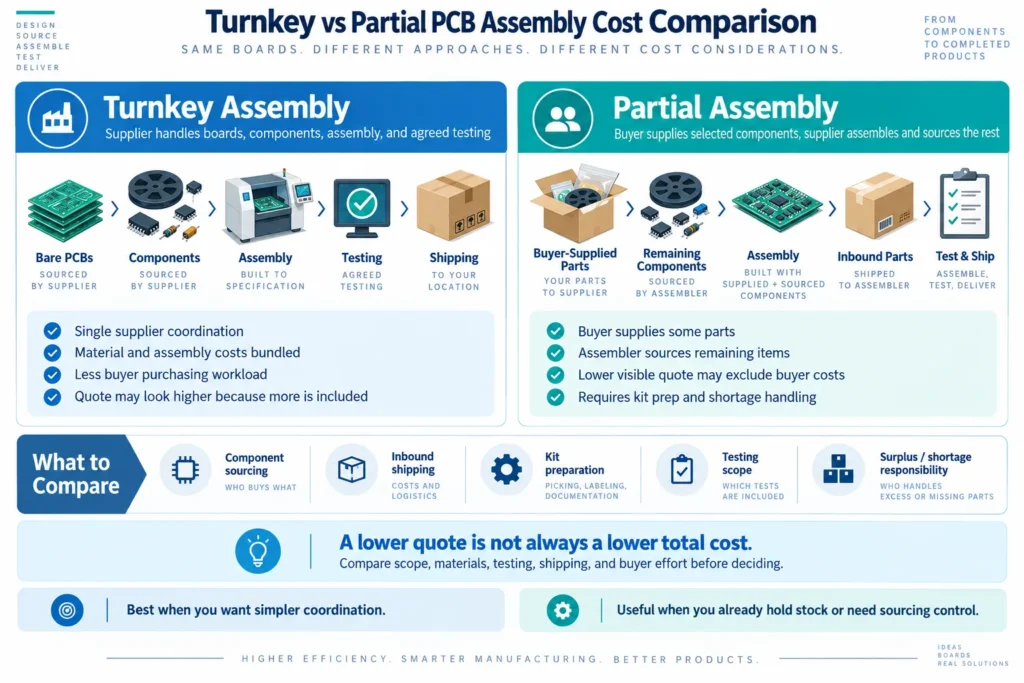
A partial or consigned quote may look lower because some material costs sit outside it. Add the buyer’s purchasing time, inbound shipping, kit preparation, and shortage handling before comparing totals.
Neither model is always cheaper. Existing component stock may favor partial turnkey. A team without purchasing resources may value turnkey coordination. Agree who owns surplus parts and handles incorrect, missing, or damaged material.
How to Reduce PCBA Cost Without Cutting Quality
Focus on avoidable work and uncertainty before asking for a discount. Useful changes include:
- Release a complete BOM. Include part numbers, quantities, reference designators, and do-not-populate items. Use the BOM preparation guide to check the file.
- Approve alternatives early. Review electrical, mechanical, firmware, and reliability needs before substitution. Discuss alternative component sourcing without assuming that matching nominal values means interchangeability.
- Review manufacturability and assembly. Ask about package access, process steps, panel utilization, and test points. Approve layout or panel changes through engineering.
- Define testing before quoting. Provide firmware, test instructions, limits, and expected records. Clarify fixture ownership and repeat-order costs.
- Plan realistic quantities and timing. Share forecasts, but distinguish firm orders from estimates. Avoid rush decisions and unnecessary inventory commitments.
- Compare identical scopes. Use the same files, revision, quantity, sourcing rules, delivery terms, and test coverage for each quote.
For a fair comparison, add setup, materials, assembly, testing, and delivery-related charges. Divide that total by the agreed delivered quantity. Compare repeat orders separately, and do not count reusable tooling as a new charge unless it actually applies.
For example, one offer might include a stencil and functional testing, while another lists only assembly labor. The second offer is not yet a cheaper equivalent. Ask both suppliers to quote the missing items before deciding. This comparison does not require an industry-average price; it requires matching deliverables.
Finally, record assumptions alongside the price: currency, quote validity, component availability, approved substitutions, and delivery terms. Confirm what happens if stock changes before order release. A clear scope helps the buyer understand which costs are fixed and which need reconfirmation.
FAQ
What is the average cost of a PCB assembly prototype order?
There is no reliable universal average for every prototype design. Components, quantity, board construction, setup, and testing can change the total substantially. Request an itemized quote using your actual files. Separate one-time charges from unit prices so the prototype can be compared with later builds.
Does turnkey assembly cost more than partial assembly?
Not necessarily. Turnkey may show a higher invoice because it includes materials that a partial quote excludes. Compare total spend, including your own sourcing, shipping, kit preparation, and shortage handling. Use the same material specifications and test requirements in both comparisons.
How does component shortage affect PCBA pricing?
A shortage may increase purchase prices, delay the build, or require split shipments and substitute-part review. Any replacement must receive the required engineering approval. Check quote validity and stock assumptions, and avoid sacrificing traceability simply to secure a lower price.
What testing adds the most cost to PCB assembly?
There is no fixed ranking. Custom functional testing can require substantial fixture and software development. Extensive X-ray inspection or long test cycles can also add cost. The answer depends on the board, coverage, volume, and existing equipment. Ask for development and recurring test charges separately.
Want an Accurate PCBA Quote?
Send Benlida your BOM, Gerber or ODB++ files, drill data, pick-and-place file, and assembly drawings. Include the revision, quantities, sourcing model, test and firmware requirements, and target delivery date. Ask for an itemized quote and a review of approved component alternatives.