

Automotive PCB Requirements — IATF 16949 and AEC-Q100 Explained
What Are Automotive PCB Requirements?
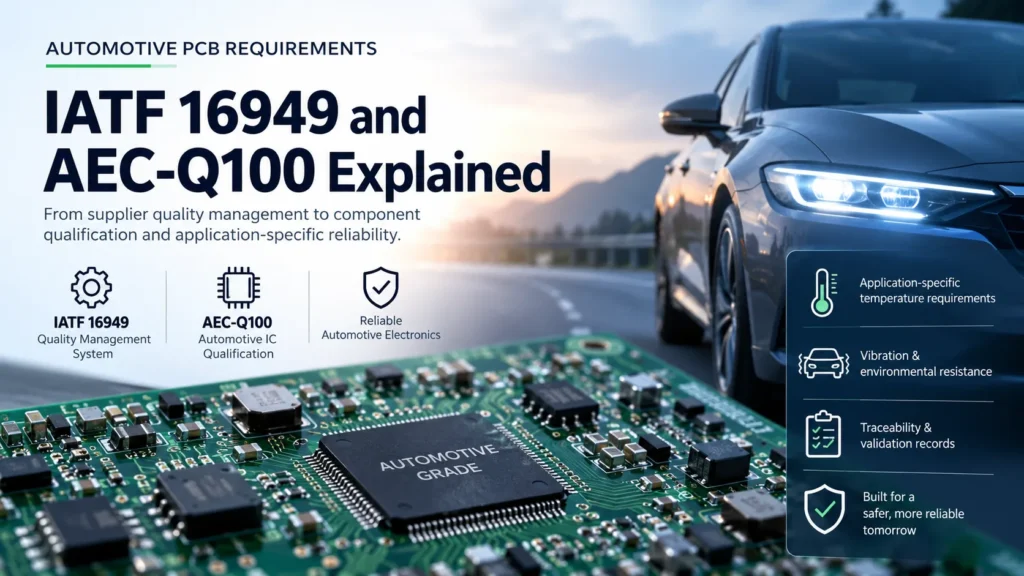
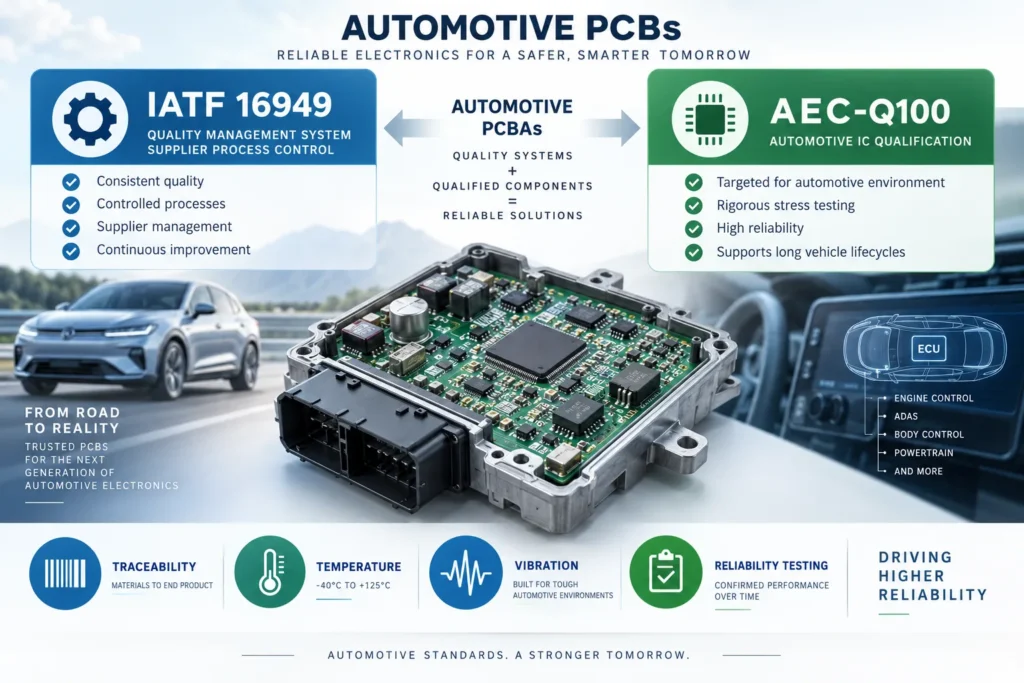
Automotive PCB requirements cover supplier quality management, board construction, component selection, and reliability under the vehicle’s operating conditions. IATF 16949 concerns the supplier’s quality management system. AEC-Q100 concerns integrated circuits. Neither replaces validation of the finished board or assembly for its actual location and service life.
A PCB is the bare board. A PCBA includes the mounted components and solder joints. Buyers need to define which product they are ordering and which evidence belongs to each stage. An AEC-qualified chip does not make its carrier board AEC-qualified.
Start with the customer’s specification and the installation location. A cabin display, an engine-mounted controller, and a power module face different stresses. Ask what “automotive grade PCB” means in the quotation. It should point to agreed materials, acceptance criteria, traceability, and validation records.
IATF 16949 Certification Explained
IATF 16949:2016 is a quality management system standard for the automotive supply chain. It builds on the ISO 9001 framework and addresses automotive customer requirements. Certification is useful supplier evidence, but it is not a product approval or a guarantee against defects.
What Buyers Should Check
Check the legal entity, manufacturing address, certification scope, certificate number, and current status. The supplier’s trading name may differ from the certified company name. Confirm that the site making your boards and the work being ordered are covered.
Then agree the project controls. Ask how material lots, manufacturing revisions, inspection results, and changes will be recorded. Clarify how nonconforming material is contained and how changes require customer approval. The exact records and retention period should match your contract.
Keep these requirements in the purchase specification rather than relying on a sales conversation. Identify which drawings control, which substitutions need approval, and which reports must accompany delivery. If an automotive customer adds special requirements, send them with the inquiry. The supplier needs them before evaluating the project, not after the first batch has been built.
If the customer requires PPAP, agree the submission scope before production. AIAG’s Production Part Approval Process addresses evidence that production can meet the engineering requirements consistently. A system certificate alone is not a completed PPAP submission.
What Benlida's Published Certificate Covers
Benlida’s published IATF 16949:2016 certificate names Shenzhen Benlida Circuit Co., Ltd. It lists PCB manufacturing as its scope and IATF number 0505178.
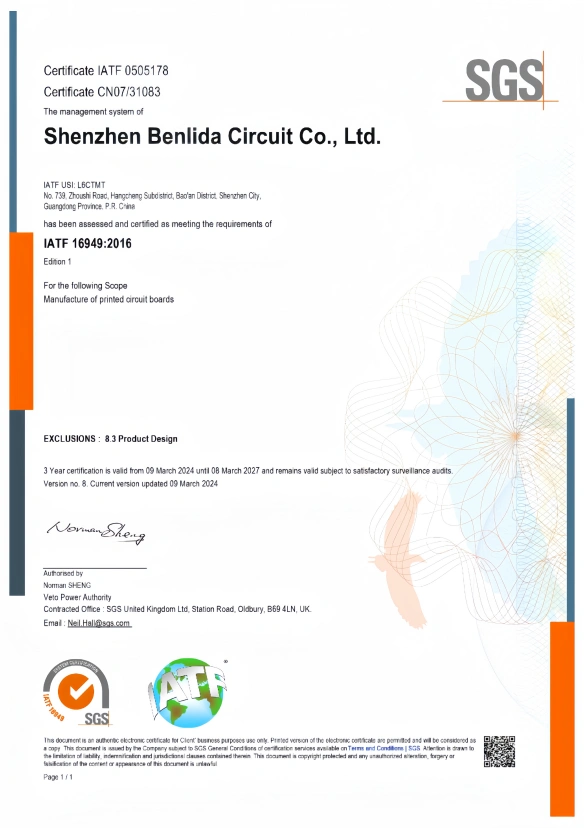
For IATF 16949 quality control documentation, request the current certificate and confirm its status, site, and scope before supplier approval. The published document does not establish certification of every automotive PCB or PCBA product.
AEC-Q100 Component Qualification
AEC-Q100 is a stress-test qualification standard for integrated circuits used in automotive applications. It addresses component reliability through defined qualification testing. It is not a certification standard for a bare PCB.
For AEC-Q100 components, check the exact orderable part number, package, temperature grade, and qualification evidence. Do not assume every variant in a product family has the same status. TI’s part-rating guidance shows why an automotive classification belongs to specific orderable parts.
Read Temperature Grades Correctly
The ranges below refer to IC ambient operating temperature, as explained in TI’s AEC-Q100 temperature-grade overview. They do not specify the board’s allowable temperature or the semiconductor junction temperature.
| AEC-Q100 grade | IC ambient operating range |
|---|---|
| Grade 0 | −40°C to +150°C |
| Grade 1 | −40°C to +125°C |
| Grade 2 | −40°C to +105°C |
| Grade 3 | −40°C to +85°C |
Check each datasheet for junction limits, electrical performance across temperature, and power derating. The chip can run hotter than the surrounding air. Select the grade from the expected local conditions, including self-heating and cooling performance.
Component qualification also does not validate the solder joints, connectors, enclosure, or complete circuit. Plan those checks at assembly and system level. A qualified replacement part still needs review for electrical, thermal, mechanical, and software compatibility.
Temperature and Vibration Requirements by Application Zone
There is no single temperature range or vibration profile for all automotive boards. ISO 16750-4:2023 addresses climatic loads for vehicle electrical and electronic equipment. ISO 16750-3:2023 addresses mechanical loads. Both relate requirements to the mounting location.
Use this comparison to frame the engineering review. It is a planning checklist, not a replacement for the customer’s environmental specification.
| Application zone | Temperature questions | Vibration questions | Design focus |
|---|---|---|---|
| Cabin, body-mounted | Cold start, parked-vehicle heat, solar load, and local self-heating | Body mounting, connector loads, and enclosure support | Verify the enclosed module's actual conditions |
| Under hood, body-mounted | Nearby heat sources, hot soak after shutdown, and cooling airflow | Vehicle-body excitation and harness movement | Assess heat paths, board support, and connector restraint |
| Engine- or powertrain-mounted | Local surface heat and repeated temperature changes | Direct mechanical excitation and assembly resonances | Validate mounting, solder joints, and component retention together |
The −40°C to +150°C range is relevant to Grade 0 IC selection. It is not a universal under-hood PCB requirement. Define the module’s ambient, board, and component temperatures separately. Include exposure duration and the number of temperature cycles over the intended service life.
Separate operating limits from storage and assembly conditions. A module may be exposed to different temperatures when powered, parked, or stored. Reflow is a short manufacturing exposure and cannot establish a long-term service rating. Describe the expected duty cycle and cooling assumptions so the design team can evaluate the actual thermal demands.
Specify the laminate grade, stackup, via structure, copper distribution, and assembly materials against that environment. Review the material supplier’s thermal data and the required service life together. Do not select the board material from a single headline temperature value.
For power designs, our guide to heavy copper for automotive power circuits discusses current-carrying and thermal design considerations. More copper alone does not prove that a board meets automotive reliability requirements.
Automotive PCB Reliability Testing
Build the test plan around possible failures and the customer’s acceptance requirements. Keep bare-board verification separate from assembly and module validation. Our overview of PCB reliability and environmental testing provides related reading across these stages.
Define the Product and Acceptance Standard
For rigid bare boards, confirm whether IPC-6012 and its automotive addendum apply to the purchase. The current IPC revision table lists IPC-6012F and IPC-6012FA. Specify the agreed editions, class, and customer additions. Do not assume a rigid-board specification also covers flexible boards.
Match inspection records to the question being answered. Electrical continuity and isolation checks look for bare-board circuit faults. Assembly inspection checks workmanship. Neither demonstrates that the complete module will survive years of temperature changes and vibration.
Make the Validation Plan Reproducible
Define these items before samples are built:
- The board and assembly revision, material construction, and sample quantity.
- The fixture, enclosure, connectors, and mounting points used during testing.
- Temperature endpoints, dwell times, transitions, and powered or unpowered operation.
- Vibration profile, axes, duration, and any combined environmental loading.
- What is monitored during exposure and what counts as an intermittent failure.
- Pass/fail limits, post-test checks, and the records needed for customer approval.
Depending on the risk, the plan may include temperature cycling, humidity exposure, vibration, mechanical shock, and electrical checks. A laboratory report should identify the sample configuration and test conditions. “Passed automotive testing” is not enough to compare two different designs.
Also distinguish design validation from routine production testing. Environmental testing on selected samples does not show that every manufactured unit has received the same exposure. Agree which checks apply to each unit, which apply to each lot, and which support design qualification. Record the sampling basis so incoming quality teams can interpret the evidence correctly.
Finally, connect the tested construction to production control. A change in laminate, component package, assembly material, or mounting can affect previous evidence. Agree who evaluates changes and when revalidation is needed. Confirm the required test scope and available support with the supplier before placing the order.
FAQ
What is IATF 16949 and why does it matter for automotive PCB?
IATF 16949 is an automotive quality management system standard. It helps buyers assess the supplier’s quality processes and customer-requirement controls. Certification must match the manufacturing site and scope. It does not certify each board design or replace project-specific acceptance and reliability evidence.
What is AEC-Q100 component qualification?
It is stress-test qualification for integrated circuits intended for automotive applications. Check qualification evidence for the exact part and its temperature grade. AEC-Q100 does not qualify a bare PCB or prove the reliability of the complete assembled module.
What temperature range must under-hood automotive PCBs withstand?
The required range depends on the mounting location, heat sources, operating duty, and customer specification. −40°C to +150°C is the AEC-Q100 Grade 0 IC ambient range, not a universal PCB limit. Verify board materials, component limits, and the assembled module under the agreed conditions.
Is Benlida IATF 16949 certified?
Benlida publishes an IATF 16949:2016 certificate for Shenzhen Benlida Circuit Co., Ltd., covering PCB manufacturing. The document lists March 8, 2027, as its expiry date. Request the current certificate and verify its status, site, and scope before supplier approval. This is management-system evidence, not certification of every automotive PCB or PCBA.
Discuss Your Automotive PCB Requirements
For automotive PCB manufacturing, send the fabrication files, drawing, quantity, and required materials. Include the installation zone, environmental profile, acceptance criteria, and documentation requirements. For PCBA, add the BOM, placement data, and assembly and test instructions. Benlida can review the inquiry so the project scope and required evidence can be discussed before ordering.