

PCB Plating Types — Gold, Silver, Tin, Nickel Comparison
What Is PCB Plating and Why Does It Matter?
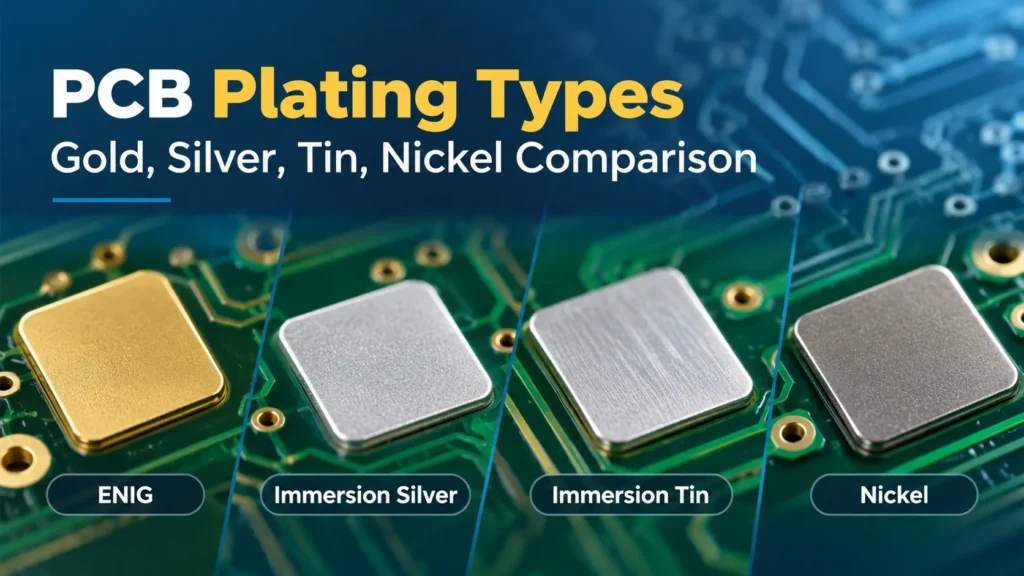
PCB plating types include ENIG, ENEPIG, immersion silver, immersion tin, and electrolytic hard gold. These metal systems protect exposed copper or provide a suitable connection surface. Select them by soldering, wire-bonding, or contact-wear requirements, then check storage conditions and cost. Nickel usually acts as an underlayer in a finish system rather than an interchangeable alternative to gold, silver, or tin.
The word “plating” also covers copper deposited in holes and on traces during fabrication. That copper creates conductive connections. This article focuses on final metal finishes applied to designated exposed surfaces.
PCB plating durability can mean storage life before soldering, resistance to corrosion, or survival of repeated connector mating. These are different requirements. A finish that stores well may still be unsuitable for sliding contacts.
For the wider comparison with HASL and OSP, see our PCB surface finish comparison guide. Solder mask is different again: it covers selected areas rather than providing a metal connection surface. Our guide to PCB solder resist best practices explains that part of the design.

ENIG (Electroless Nickel Immersion Gold) Overview
ENIG places electroless nickel over copper, followed by a thin immersion-gold coating. The nickel limits copper diffusion. The gold protects the nickel before assembly. This layered structure is why an ENIG gold-plating specification must define more than “gold finish.”
ENIG provides a flat surface for fine-pitch soldering. During soldering, the thin gold coating dissolves into the solder. It is not intended to act as a thick wear layer on the finished connection.
Process control matters. Technic’s explanation of black pad connects abnormal nickel corrosion with unreliable solder interfaces. Ask the fabricator how it controls deposition, checks thickness, and evaluates corrosion. A gold-colored pad is not proof of a sound layer underneath.
ENIG is not automatically unsuitable for every wire bond. The IPC-4552B scope includes aluminum and copper wedge bonding. However, that does not make ordinary ENIG a universal gold-ball-bonding finish. Specify the wire material and bonding method before approving the coating.
Immersion Silver — Cost and Limitations
Immersion silver deposits a thin silver layer on copper without the nickel barrier used in ENIG. It provides a solderable surface and is a candidate when a nickel-free finish is preferred. Its thin coating follows the underlying copper; it will not repair an uneven pad.
Storage and handling need attention. IPC’s published immersion-silver guidance identifies moisture, sulfur, and chlorine contamination as factors that can shorten useful life. Keep boards in the fabricator’s specified packaging and avoid touching exposed pads.
For corrosive service environments, agree on environmental testing and assembly protection before choosing silver. Appearance alone cannot establish solderability or long-term reliability. Have questionable discoloration assessed against the agreed acceptance criteria.
Silver can be a cost-saving candidate compared with a nickel/gold system. However, compare quotations for the same board and quantity. Protective handling, inspection, and storage requirements still affect the overall purchasing decision.
Immersion Tin — Whisker Risk and Shelf Life
Immersion tin forms a thin tin coating on copper. It provides a planar surface for soldering and can suit qualified press-fit applications. Unlike ENIG or ENEPIG, it does not need a precious-metal top layer.
Copper and tin continue to interact during storage. They form intermetallic compounds, leaving less free tin available for soldering. IPC’s immersion-tin guidance links storage performance to deposit thickness and copper-tin diffusion. Total coating thickness alone does not describe the remaining solderable tin.
Tin whiskers are small conductive growths that can create short-circuit risks. Stress, including press-fit insertion, deserves attention. Modern processes can reduce this risk: MacDermid Alpha’s ORMECON CSN information describes controls for diffusion and whisker formation. Do not turn one process claim into a guarantee that all immersion-tin boards are whisker-free.
Share the planned storage period and thermal history with the fabricator. Review any proposed baking or rework before applying it; additional heat can change the finish’s condition.
Electroless Nickel Electroless Palladium Immersion Gold (ENEPIG) for Wire Bonding
ENEPIG adds electroless palladium between nickel and immersion gold. From the copper pad outward, the sequence is nickel, palladium, then gold. The palladium separates the nickel from the gold deposition step.
ENEPIG is a candidate when an assembly combines soldered components with wire-bonded devices. For example, MacDermid Alpha’s Affinity ENEPIG process is designed for soldering and wire bonding. This is evidence of a process application, not proof that every ENEPIG board meets every bond requirement.
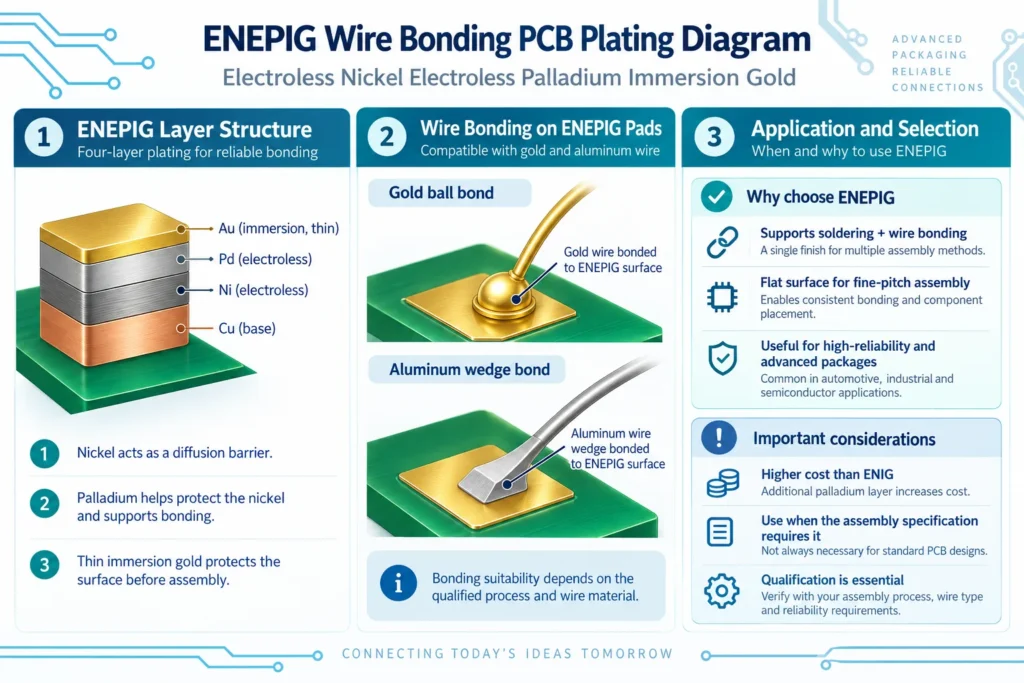
Agree on the wire metal, bonding method, layer thicknesses, cleanliness, and acceptance tests with the assembly team. Check performance after the actual storage and heating sequence. A finish name alone cannot establish bond strength or eliminate corrosion risk.
ENEPIG adds palladium and another deposition stage. Compare its quoted cost with the connection requirements it satisfies. It is not a necessary upgrade for every board that already works with ENIG.
Plating Type Selection by Application
Start with the connection, not the metal’s appearance. The table compares selection factors rather than guaranteed prices or storage periods. “Best Use” means a candidate application that still needs engineering approval.
PCB Plating Comparison
| Plating Type | Shelf Life | Solderability | Cost | Best Use |
|---|---|---|---|---|
| ENIG | Confirm the qualified storage window and packaging | Flat soldering surface; nickel condition matters | Nickel/gold process; compare full-board quotes | Fine-pitch assembly with defined storage needs |
| Immersion silver | Packaging and contamination control are important | Solderable when correctly processed and handled | Cost-saving candidate; no nickel/gold stack | Assembly requiring a thin, nickel-free finish |
| Immersion tin | Depends on free tin, storage, and heat history | Qualify the planned thermal sequence | No precious-metal topcoat; obtain a project quote | Soldering and qualified press-fit connections |
| ENEPIG | Confirm solderability and bondability after storage | Suitable for qualified mixed soldering/bonding processes | Additional palladium layer and process step | Boards combining soldering and wire bonding |
| Electrolytic hard gold over nickel | Confirm storage conditions; qualify wear separately | Contact finish; review soldered areas separately | Gold thickness, plated area, and selective processing matter | Repeated-mating edge contacts |
Storage figures need context. Melexis’s SMT guidance gives typical examples of 12 months for ENIG/ENEPIG and six months for immersion tin. It explicitly makes these dependent on manufacturer and storage conditions. In contrast, Atotech reports 12-month storage performance for a specific Stannatech tin process. These examples are not interchangeable guarantees or Benlida commitments.
For repeated connector mating, distinguish hard gold from thin immersion gold. Eurocircuits’ edge-connector explanation describes why hard gold is used for repeated abrasion. A board may need selective hard gold on fingers and a solderable finish elsewhere. Confirm the manufacturing route rather than specifying one finish everywhere.
Before requesting a quote, record the details that change the selection:
- Which areas will be soldered, wire bonded, press fitted, or repeatedly mated.
- The assembly sequence, expected storage period, and packaging requirements.
- The agreed finish specification, revision, thickness requirements, and test evidence.
- The operating environment, including humidity or corrosive contaminants.
When comparing immersion silver vs tin, consider how the boards will move through storage and assembly. Do not choose solely by the initial plating quote. Review these requirements alongside our PCB manufacturing services, then confirm the available process for the exact design.
FAQ
What is the most common PCB plating type?
ENIG is a common final metal finish for soldered PCBs. Usage varies by product and assembly process, so it should not be described as the universal market leader. Copper plating serves a different fabrication role and should not be confused with a final surface finish.
Does immersion tin have a shorter shelf life than ENIG?
The Melexis example above gives tin a shorter storage window than ENIG. Some qualified tin processes support longer periods. Compare the actual supplier’s limits, packaging instructions, deposit condition, and heating history. Neither a finish name nor a generic six- or twelve-month figure establishes acceptance.
When is ENEPIG required instead of ENIG?
Use ENEPIG when the assembly specification or qualified bonding process requires it. It is often considered for combined soldering and wire bonding. It is not mandatory for every wire bond, since suitable ENIG processes can support certain wedge-bond applications.
Does plating type affect PCB assembly reliability?
Yes. The finish affects wetting, interfacial metallurgy, and compatibility with the connection process. Reliability also depends on fabrication control, cleanliness, storage, and assembly conditions. Verify the complete process rather than treating a more expensive coating as automatic protection against failure.
Not Sure Which Plating Fits Your Application?
Discuss plating options for your board with Benlida. Share Gerber or ODB++ files, drill data, fabrication notes, quantity, and intended assembly date. Identify any wire-bond pads, press-fit holes, or gold fingers.
Ask for a project-specific review of solderability, storage, and connection requirements. Confirm finish availability, acceptance criteria, and any proposed alternatives before releasing the board for production.