

PCB Quality Control Process — What Happens Before Shipping

What Happens During PCB Quality Control?
The PCB quality control process checks materials, manufacturing steps, finished boards, and packaging before shipment. It compares inspection results with the approved design and purchase requirements. A useful QC plan states what is checked, how often, and which records support release. One final inspection cannot replace checks throughout production.
This guide focuses on bare PCBs: boards without installed components. PCB assemblies, or PCBAs, need additional checks for components, solder joints, and specified functions. Passing a bare-board test does not prove that the finished electronic product will work.
Start by agreeing on the drawing revision, acceptance criteria, and required reports. For rigid boards, IPC-6012 covers qualification and performance requirements. It is not a universal specification for every board technology. Record the applicable standard editions and product class in the order.
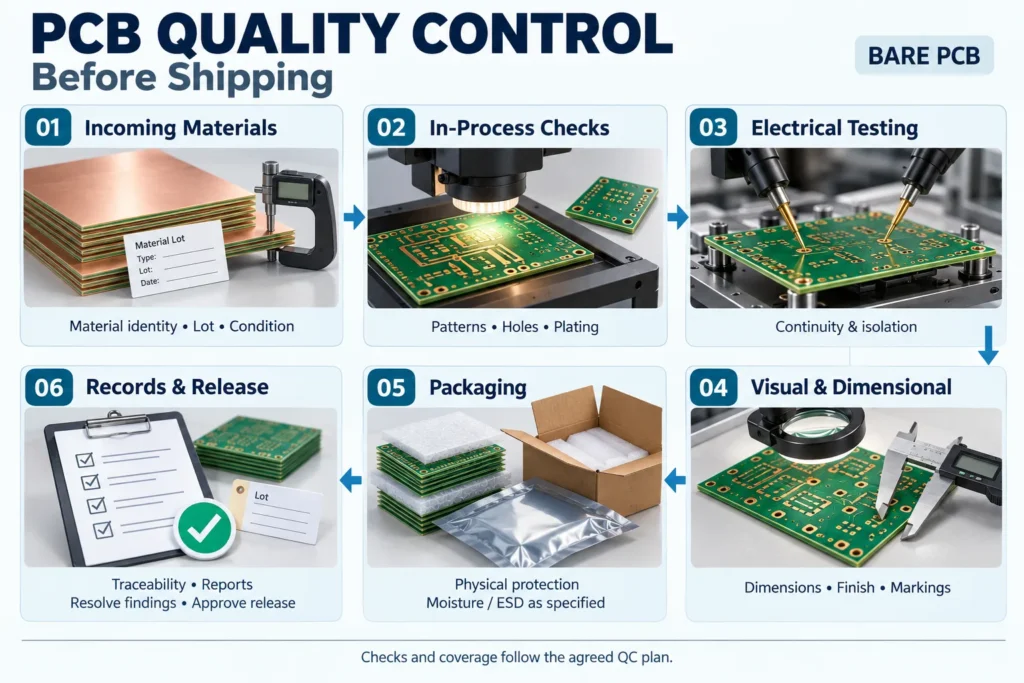
Use this PCB QC checklist to organize the discussion. It is a planning framework, not a promise that every listed check applies to every board.
QC Stage Table
| Stage | What's Checked | Standard Referenced |
|---|---|---|
| Incoming materials | Material identity, lot, specified thickness, and storage condition. | Approved material data; IPC-4101 where applicable. |
| In-process checks | Copper patterns, registration, holes, plating, and process records. | Approved control plan; applicable fabrication specification. |
| Final electrical testing | Continuity and isolation against approved circuit data. | Agreed electrical test specification and acceptance limits. |
| Final visual and dimensional inspection | Board condition, dimensions, markings, and specified workmanship. | Fabrication drawing; IPC-A-600 and IPC-6012 where applicable. |
| Packaging | Cleanliness, physical protection, seals, and required moisture/ESD controls. | Order packing specification; IPC-1602; ANSI/ESD S541 when relevant. |
| Records and release | Lot identity, required results, resolved nonconformities, and release approval. | Purchase requirements and the agreed quality plan. |
Incoming Material Inspection
Incoming inspection asks a basic question: are these the materials approved for this build? Check the supplier’s labels and documents against the fabrication requirements. Relevant details include laminate grade, prepreg construction, copper thickness, lot identity, and material condition.
FR-4 alone is not a complete material specification. The IPC-4101 material specification covers base materials for rigid and multilayer printed boards. The selected material still needs to match the project’s electrical, thermal, and manufacturing requirements.
Review packaging damage, storage history, and any supplier-defined storage limits. Decide which properties need physical verification and which are supported by supplier records. A label check and a laboratory material test provide different evidence.
Keep questionable material separate until its status is resolved. If a substitute is proposed, review its effect on the approved design before use. For traceability, ask how incoming material lots are linked to the production order.
In-Process Checks at Each Manufacturing Stage
Some defects become harder to inspect after the next manufacturing step. Inner-layer copper patterns, for example, are accessible before multilayer lamination. Automated optical inspection can compare those patterns with manufacturing data to identify suspect features.
Later checks may cover layer registration, board thickness, drill position, and hole quality. Plating controls address deposited copper, including copper inside plated holes. Solder mask and surface-finish checks follow their respective processes. The control plan should specify methods, limits, and inspection frequency.
Not every property can be verified by looking at a finished board. Cross-sections reveal selected internal features by cutting and preparing a specimen. Coupons or sampled boards can provide evidence without destroying every shipped unit. Ask what the sample represents and how it is linked to the production lot.
Bare-board pattern inspection also differs from AOI testing in PCB assembly. Assembly AOI examines populated-board features, such as component placement and visible solder conditions. These processes should not be treated as interchangeable.
A practical QC plan should also define what happens after a failure. Hold affected material, assess the cause, and document the decision. Rework needs approval and appropriate reinspection. Unresolved findings should not disappear simply because the shipping date is close.
Final Electrical and Visual Testing
PCB final inspection combines checks that answer different questions. Electrical testing looks for incorrect connections or missing connections. Visual and dimensional inspection checks physical features against the agreed requirements.
For bare boards, IPC’s electrical testing guidance addresses conductive networks. Continuity testing looks for opens in intended connections. Isolation testing looks for unwanted connections between networks. Flying probes or fixtures may be used, depending on the agreed method.
Confirm the source and revision of the test data. Testing against the wrong netlist can give misleading confidence. Ask which parameters and limits are used, what coverage is achieved, and how failures are handled.
Electrical testing does not establish every physical or reliability characteristic. It also does not run firmware or validate the completed product’s function. If impedance, structural verification, or other checks are required, list them separately.
IPC-A-600 describes bare-board acceptability through externally and internally observable conditions. It is not just a surface appearance guide. A final visual check cannot replace the internal examination needed for a specified characteristic.
For shipping release, review applicable dimensions, surface condition, solder mask, identification, and other drawing requirements. Make the inspection scope explicit. “100% tested” must name the test and its coverage; it does not mean every possible defect has been excluded.
Sampling must also be agreed for each relevant check. For populated-board projects, the guide to PCB assembly inspection levels explains the separate roles of sampling and unit-level testing.
Packaging and Moisture/ESD Protection Standards
Packaging preserves board condition after inspection. IPC-1602 addresses printed-board handling and storage, including contamination, physical damage, solderability, and moisture uptake. The packing method should match the board construction, surface finish, expected storage, and assembly needs.
Where dry packing is specified, agree on the moisture-barrier bag, desiccant, humidity indicator, and sealing requirements. A vacuum-packed appearance alone does not establish moisture protection. Keep labels readable and use suitable separation and cushioning to protect boards during transport.
Moisture control and electrostatic discharge protection are separate requirements. ANSI/ESD S541 defines packaging properties for ESD-sensitive items. Do not assume every bare board has the same ESD needs as an assembly containing sensitive components.
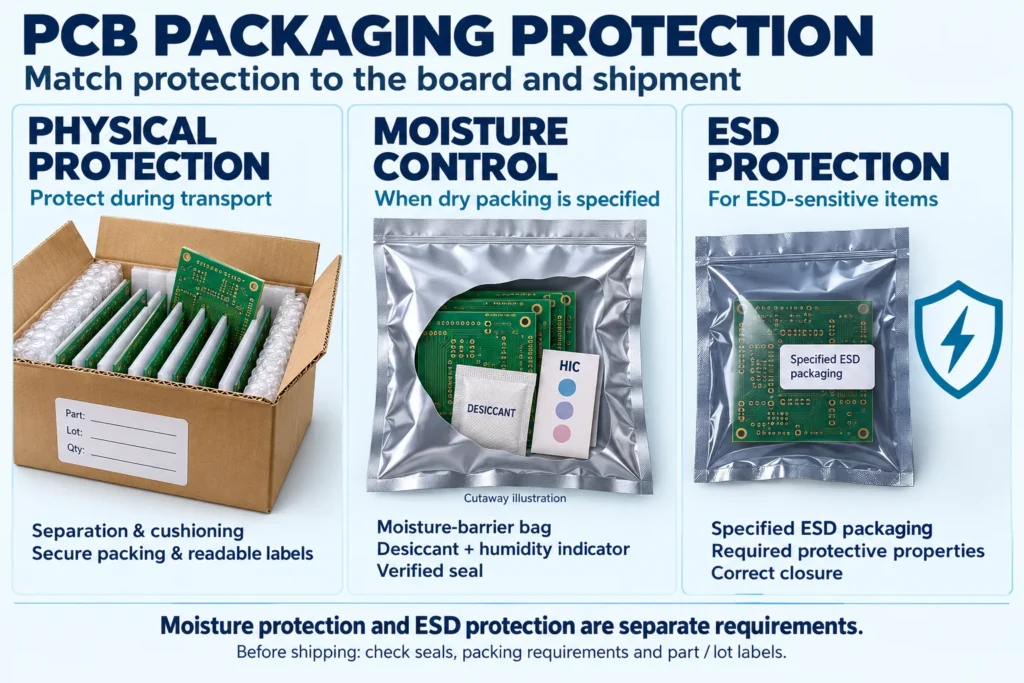
Do not transfer a component’s moisture sensitivity level or baking instructions directly to a bare PCB. Board-specific handling guidance matters. If packaging is damaged or storage limits are exceeded, seek engineering guidance before assembly rather than applying a universal baking recipe.
Documentation and Traceability Records
Useful records connect a shipment to a defined build and its acceptance evidence. Agree on the report package before production. Request documents that support your receiving inspection and any later investigation.
- Part number, revision, purchase order, quantity, and lot identification.
- Required material and process traceability records.
- Inspection or test results, with methods and acceptance criteria.
- Identification of sampled boards or coupons where applicable.
- Approved deviations, final disposition, and release authorization.
Clarify whether reports are supplied with the shipment or retained for later access. Also agree on retention periods. A certificate of conformity and detailed measurement data are different deliverables.
ISO 9001 concerns an organization’s quality management system. As ISO explains in its certification guidance, management-system certification is not product certification. Verify a supplier’s certificate entity, site, scope, and validity separately. A certificate alone does not establish which tests or reports your order includes.
FAQ
What is checked during incoming material inspection?
Material identity, specified properties, lot information, documents, and delivery condition are checked against the approved requirements. The control plan determines which properties need measurement or testing. Storage conditions and proposed substitutions also need review.
Does Benlida provide QC documentation with each shipment?
Confirm the included documents with Benlida before placing the order. Name the reports you need in the quotation or purchase requirements. Ask whether they cover individual boards, sampled items, or the lot, and when you will receive them.
What packaging standards protect PCBs during transit?
IPC-1602 sets requirements and recommendations for printed-board handling and storage. ANSI/ESD S541 is relevant when ESD-sensitive items require protective packaging. Specify the actual packing configuration for the board and shipment; citing a standard alone does not define it.
Is final testing included for every order regardless of volume?
Confirm the included tests, coverage, and reports in the quotation. Order volume alone does not establish the test scope. Distinguish electrical testing from visual inspection, sampled structural checks, and any additional verification your project requires.
Want Full Visibility Into Your Order's QC Process?
Review Benlida’s PCB quality control services. Ask about our QC process for your project.
Send Gerber or ODB++ data, drill files, the fabrication drawing, quantity, and revision. Include material, finish, acceptance, testing, packaging, and reporting requirements. Ask Benlida to confirm the proposed QC scope before production, so your purchasing and receiving teams know what evidence to expect.