

Turnkey PCB Assembly vs Partial Assembly — Pros and Cons
Turnkey vs Partial PCB Assembly — Core Difference
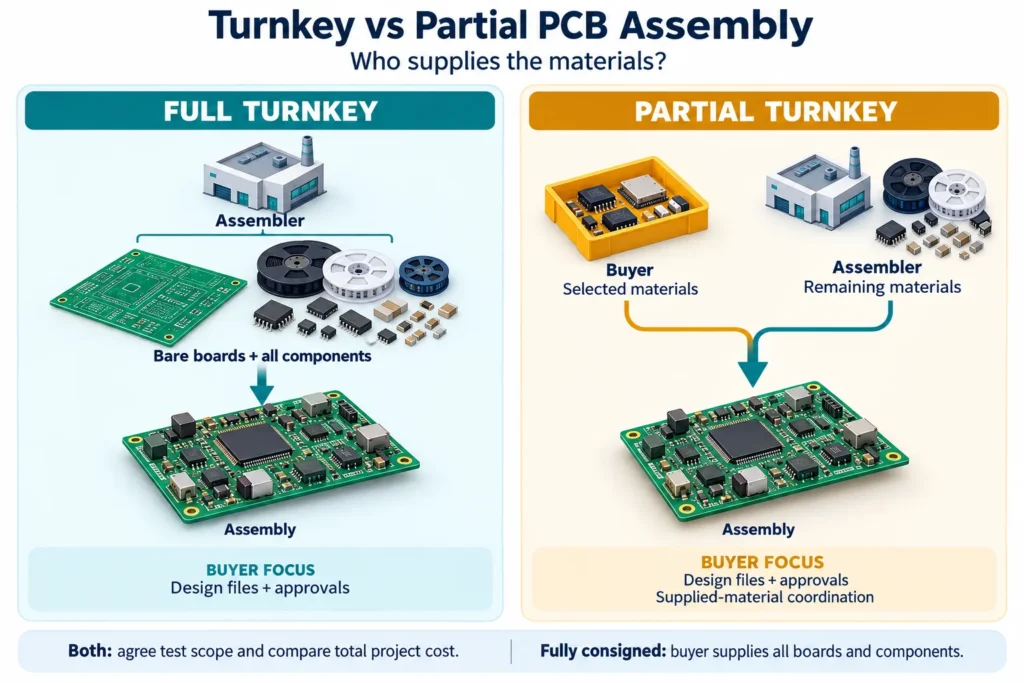
The core difference in turnkey vs partial PCBA is who supplies the materials. In full turnkey assembly, one supplier procures the bare boards and all components, then coordinates assembly and the agreed testing and delivery. Partial turnkey splits sourcing between the buyer and assembler. In fully consigned assembly, the buyer supplies all boards and components.
A PCB is the bare circuit board. A PCBA is the board with components installed. Here, “partial” describes the sourcing arrangement, not a board with only some components fitted. Supplier terminology can vary, so list the actual responsibilities in the quote.
None of these models automatically provides better workmanship or broader testing. Inspection, programming, functional testing, and acceptance requirements need their own agreed scope.
Turnkey vs Partial Assembly
| Factor | Turnkey | Partial Turnkey / Fully Consigned |
|---|---|---|
| Material sourcing | Supplier purchases boards and components. | Buyer supplies selected items in partial turnkey; all materials in fully consigned assembly. |
| Buyer workload | Focus on design data, approvals, and order review. | Also manage purchased items, kit preparation, and inbound deliveries. |
| Substitutions | Agree approval rules before procurement. | Apply agreed approval rules to both sourcing streams. |
| Build readiness | Depends on supplier procurement and approved files. | Also depends on customer-supplied material readiness. |
| Cost comparison | Quote includes the agreed material purchases. | Add buyer purchases and handling to the assembly quote. |
| Surplus inventory | Agree who pays for and owns excess purchases. | Agree handling of supplied stock and any supplier-purchased excess. |
| Inspection and testing | Defined by the project, not the purchasing label. | Defined by the project, not the purchasing label. |
Turnkey Assembly — Advantages and Trade-Offs
Full turnkey offers one coordination point for boards, components, and assembly. It can reduce the buyer’s work on purchase orders, material shipments, and kit preparation. This is useful when a small engineering team has no dedicated purchasing staff.
The trade-off is that sourcing decisions move further from the buyer’s daily control. Ask how the supplier selects purchasing channels, reports unavailable items, and obtains approval for changes. An approved bill of materials, or BOM, should identify manufacturer part numbers and permitted alternatives.
Turnkey does not remove the need for design decisions. Your team still needs to resolve BOM errors, approve substitutions, and provide test requirements. Delayed approvals can hold up procurement even when the assembler manages the purchasing.
Also ask about minimum purchase quantities and material commitments. A prototype may use fewer components than the purchased pack contains. Clarify excess-stock ownership and cancellation conditions before placing the order.
When evaluating turnkey PCB assembly services, request a written scope. Separate board fabrication, component procurement, assembly, programming, testing, and shipping. A service label is not a substitute for an agreed deliverables list.
Partial and Consigned Assembly — When They Make Sense
Partial turnkey can suit a buyer who already holds selected approved parts. For example, the buyer might supply a project-specific processor while the assembler purchases the remaining BOM and bare boards. Fully consigned assembly goes further: the buyer prepares the complete material kit.
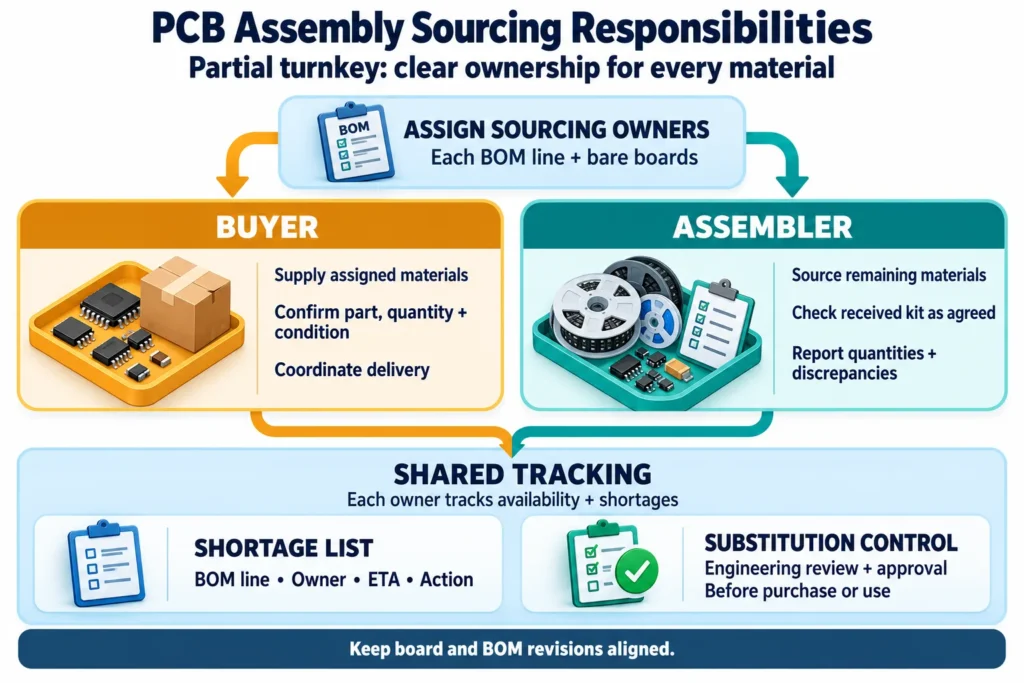
These arrangements can preserve existing purchasing agreements or make use of suitable inventory. They also place more preparation work on the buyer. Each BOM line needs a clear sourcing owner. Assign bare-board sourcing separately, since component responsibility alone does not settle it.
Before shipping a kit, confirm the assembler’s packaging, labeling, and extra-quantity requirements. Labels should connect the supplied material to the BOM. Ask how incoming quantities and discrepancies will be checked and reported.
Existing stock also needs a condition review. TI’s component-storage guidance explains the importance of packaging and customer storage conditions. For moisture-sensitive parts, review the bag labels and available handling history. Do not assume loose or previously opened stock is ready for assembly.
Agree what happens to unused parts: return, approved storage, or another documented disposition. Include handling costs and inventory records in that discussion. Supplying components saves little coordination effort if neither side knows what arrived or what remains.
Sourcing Risk and Component Shortage Exposure
No purchasing model makes shortages disappear. A single unavailable component can affect the build under either arrangement. The useful question is who detects the shortage, who acts on it, and who approves the response.
Start with availability. TI describes future inventory dates as estimates that may change. Ask whether material is actually allocated to your order or merely expected to become available. Confirm when the quoted assembly lead time starts and which conditions must be met.
Next, agree acceptable sourcing channels. TI’s anti-counterfeit guidance warns that parts obtained outside authorized channels may be counterfeit or unreliable. Ask for the purchasing source and available traceability records. A turnkey label alone does not verify component authenticity.
Alternative parts need engineering review. DigiKey’s substitution guidance calls for datasheet checks and notes that IC pinouts matter. Review the package, ratings, and application requirements before approval. Discuss component sourcing flexibility alongside a written process for approving changes.
For a mixed-sourcing order, maintain one shortage list across both parties. Record the affected BOM line, sourcing owner, expected date, and proposed action. A missing customer-supplied part does not authorize an unapproved substitute, omitted component, or partial shipment. Agree those decisions explicitly.
Keep the board revision, BOM revision, and approved changes linked. A component arriving on time is not helpful if it belongs to the previous design.
Cost Comparison Between the Two Models
Compare total project cost, not just the assembler’s invoice. A consigned quote can look lower because the buyer’s component and board purchases sit outside it. Conversely, a turnkey quote may include sourcing and material-handling work that your team would otherwise perform.
Use the same board revision, BOM, build quantity, and test scope for both quotations. Then compare:
- Board and component purchases, including minimum purchase quantities.
- Assembly setup, fixtures, programming, and agreed testing.
- Inbound freight, kit preparation, and receiving charges.
- Internal purchasing time and shortage follow-up.
- Unused inventory, storage, returns, and agreed material commitments.
- Rework or replacement arrangements for nonconforming supplied materials.
Existing inventory is not automatically free. It has a purchase cost and may need inspection or repacking. Likewise, a supplier’s larger purchasing volume does not guarantee a lower price for your particular BOM.
Separate one-time charges from repeat-order costs. Ask whether an existing fixture or program can be reused after a design change. Also separate the first build’s material purchase from components left for later orders. Otherwise, one quote may charge for future inventory while another covers only the current build.
Ask each supplier to show inclusions, exclusions, and quote validity. For broader pricing drivers, see the guide to PCB assembly cost factors. Use this comparison to decide who should handle procurement, not to assume one model is always cheaper.
Which Model Fits First-Time vs Repeat Buyers
For a first prototype, full turnkey can be practical when the team needs purchasing support and has no usable inventory. The buyer can focus on complete design files, sourcing approvals, and a clear test plan. It is still important to review the BOM before parts are ordered.
Partial turnkey may fit a first-time buyer who already owns critical parts or must use a nominated source. Confirm that the supplied items meet the assembler’s requirements before choosing this route.
Repeat buyers should reassess the model instead of carrying it forward automatically. A stable BOM and organized inventory may support partial or fully consigned builds. Frequent revisions, limited purchasing resources, or fragmented deliveries may favor turnkey coordination.
Consider a hypothetical team with approved processors already in stock. Supplying those processors while the assembler sources the rest may avoid buying them again. But the team must confirm the exact part number, condition, quantity, and arrival date. If the processor changes in the next revision, the same arrangement may no longer help. This is a purchasing decision to revisit with each revision, not evidence that partial turnkey is always the better option.
Before deciding, answer three questions: Which materials can we reliably supply? Who will manage shortages and approvals? Can both quotes support the same acceptance and test requirements?
Choose the model that fits your team’s actual capacity and material readiness. Neither company size nor order quantity alone decides the answer.
FAQ
Is turnkey assembly more expensive than partial assembly?
Not necessarily. Turnkey includes agreed material purchases, while partial assembly leaves some purchases with the buyer. Compare both sides’ costs, including freight, preparation, purchasing time, and unused stock. Keep the BOM, quantity, and test scope the same.
Who is responsible for component shortages in partial assembly?
Assign a sourcing owner to each BOM line. That owner should track availability and report shortages. Agree replacement purchasing, extra charges, and schedule changes in advance. The sourcing split alone does not settle every consequence of a shortage.
Can I mix turnkey and consigned components in one order?
Yes, if the assembler accepts the arrangement. This is commonly called partial turnkey. Mark each item as customer-supplied or assembler-purchased, and assign bare-board sourcing too. Confirm incoming checks, extra quantities, substitution approval, and treatment of unused materials.
Which model is better for a first-time prototype order?
Full turnkey is often practical when the buyer lacks purchasing resources. Partial turnkey can make sense when approved parts are already available. Choose based on the BOM, inventory condition, and support needed. Neither option replaces engineering review or an agreed test plan.
Deciding Between Turnkey and Partial Assembly?
Ask Benlida to compare sourcing options for your project. Share the BOM, Gerber or ODB++ files, pick-and-place data, assembly drawing, quantity, and revision. Include programming, test, and delivery requirements. Identify any customer-supplied boards or components.
Request a turnkey assembly quote and ask which scope fits your needs. Confirm sourcing responsibilities, material readiness, and acceptance requirements before ordering.