

How to Write a PCB Assembly Specification
What Is a PCB Assembly Specification?
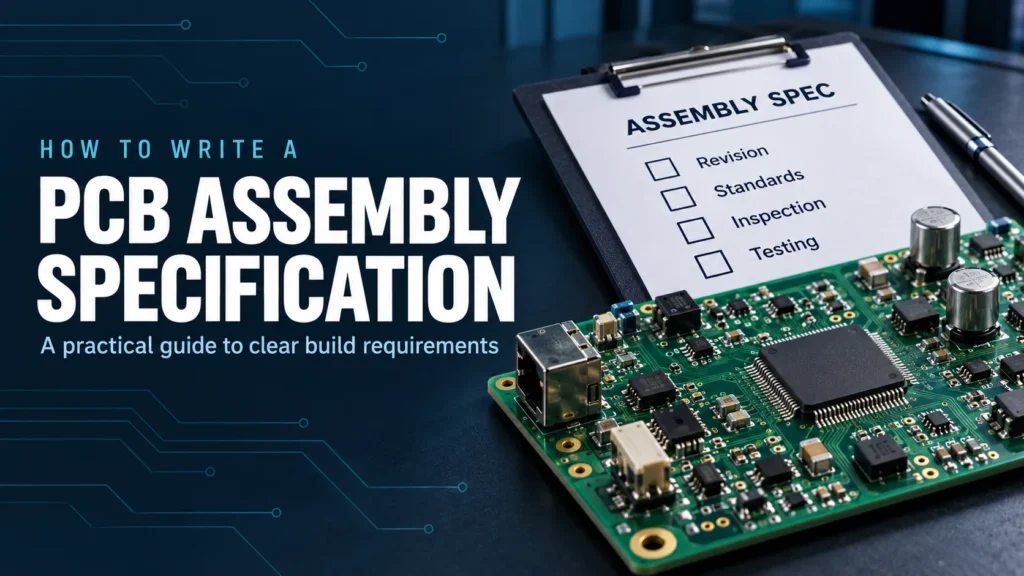
A PCB assembly specification defines how an assembled board must be built, inspected, and accepted. It records the IPC class, applicable standards, test requirements, cleaning or coating needs, and special workmanship instructions. A clear specification gives the buyer and assembler the same reference before quoting and production.
Start with the assembly part number and revision. Then describe the required result and how it will be verified. Avoid broad instructions such as “good quality” or “inspect carefully.” They leave too much room for interpretation.
This document supports the manufacturing files. The bare PCB data describes the board; the assembly specification addresses the populated PCBA. It does not replace the BOM, placement file, assembly drawing, or test procedure. Keep these documents synchronized. Our PCB BOM preparation guide explains the component data needed alongside the specification.
A useful PCBA spec document can be concise. Its value comes from clear requirements, controlled revisions, and named approvals. Send it with the RFQ so inspection, testing, and documentation work can be included in the quotation.
Defining IPC Class Requirements (Class 1, 2, 3)
Select the product class around intended use and the consequences of failure. The three classes broadly describe these needs:
- Class 1: General products where the completed assembly’s basic function is the main requirement.
- Class 2: Products requiring sustained performance and long service life, where an interruption is not critical.
- Class 3: Products where reliable operation when needed is critical, potentially under harsh conditions.
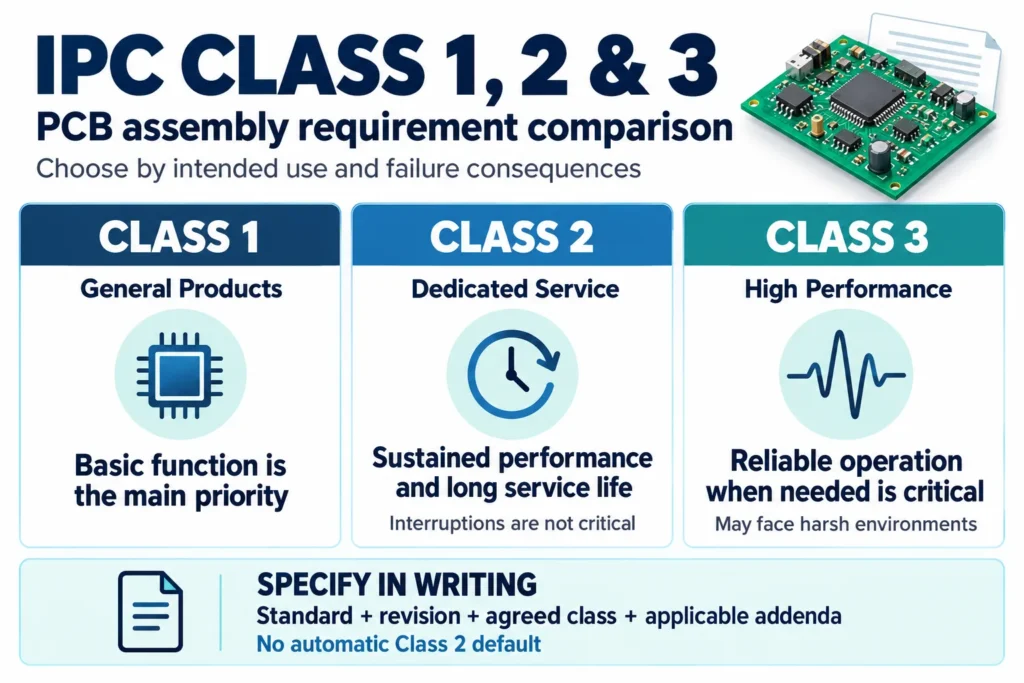
Do not assume that an unspecified order automatically becomes Class 2. The IPC J-STD-001J classification provisions assign class selection to the user. They allow the manufacturer to establish it when the user has not documented it. Agree on the class in writing.
Identify the standard as well as the class. IPC-A-610 addresses assembly acceptance. J-STD-001 covers soldering materials, processes, and related requirements. The IPC explanation of these companion standards clarifies why projects often use both. Writing only “IPC compliant” leaves the governing requirements unclear.
Record each standard’s revision and any applicable addendum. A newly released revision does not automatically replace the agreed edition. Have engineering and quality review the selection before order release.
A Class 3 requirement also does not establish medical, automotive, or aerospace certification. Identify any separate product or customer requirements explicitly.
Inspection and Acceptance Criteria to Include
Explain what will be checked, which criteria apply, and what evidence must accompany the shipment. An assembly workmanship standard and an inspection plan answer different questions. One defines acceptable conditions; the other explains how the order will be evaluated.
Cover these items in the specification or a referenced inspection plan:
- Assembly checks: Correct parts, polarity, orientation, solder joints, mechanical hardware, and visible damage.
- Inspection methods: Visual inspection, AOI, or X-ray where appropriate, with defined coverage and acceptance criteria.
- Electrical verification: Required continuity, in-circuit, or functional tests, including limits and fixture responsibilities.
- Records: Required inspection reports, test results, traceability identifiers, and approval signatures.
For hidden joints, define the packages or locations to examine and the agreed evaluation method. Do not write “X-ray pass” without a criterion. Functional testing also needs a controlled procedure, operating conditions, and measurable pass/fail limits.
If sampling is permitted, name the sampling plan, lot definition, inspection level, and relevant AQL values. Include acceptance and rejection rules. NIST’s explanation of acceptance sampling shows that sampling supports a decision about a lot. It does not verify every individual assembly.
IPC class and sampling inspection level are separate choices. Our guide to PCB assembly inspection levels explains the sampling side. State any checks required on every unit separately. Also define how failed units, rejected lots, and retesting will be handled.
Conformal Coating and Cleaning Requirements
State whether conformal coating is required. If it is, identify the approved material, coverage areas, cured-film thickness, and inspection criteria. Reference a coating drawing with clear boundaries.
Mark connectors, test contacts, and sensitive components that must remain free of coating. HumiSeal’s masking guidance explains why these areas need specific attention. Define allowable edge tolerances and how masking will be checked after removal.
Specify the thickness measurement method and locations. Access and substrate type affect the available measurement options, as described in DeFelsko’s coating measurement guidance. If witness coupons are used, define their role. A coupon reading does not directly measure every coated surface on the assembly.
Include the approved cure conditions. Do not treat a touch-dry surface as proof of completed cure. For example, the Electrolube AFA-F technical data sheet distinguishes these stages. It also calls for compatibility evaluation when coating a no-clean assembly.
For cleaning, define whether residues must be removed and how cleanliness will be verified. Record the test method, acceptance limits, and required evidence. “No-clean” flux does not automatically establish compatibility with a coating or the operating environment.
Use the selected material’s documentation and approved process requirements. Avoid copying one product’s thickness or cure schedule into every order. See our PCB conformal coating thickness guide for further planning considerations.
Special Workmanship Notes and Exceptions
Use this section for requirements that standard acceptance criteria cannot fully describe. Reference the affected component or drawing location so production teams can find each instruction.
Examples include connector alignment, mounting hardware torque, adhesive locations, wire routing, and labels. Specify tolerances and verification methods where needed. A photo can clarify an instruction, but should not replace a measurable requirement.
Document unpopulated positions and approved component alternatives consistently across the BOM and assembly drawing. Define who can approve substitutions. Include firmware revision, programming files, verification steps, and serialization rules when programming is required.
State whether rework or repair needs customer approval. Identify required records and any restrictions on affected parts. Do not assume a verbal agreement from a previous build applies to the next revision.
Give each exception an identifier, scope, approval owner, and validity period or lot reference. Require written resolution when the purchase order, drawing, and specification disagree. Document precedence in the agreed order package. Do not let operators decide which conflicting instruction to follow.
Assembly Specification Template Checklist
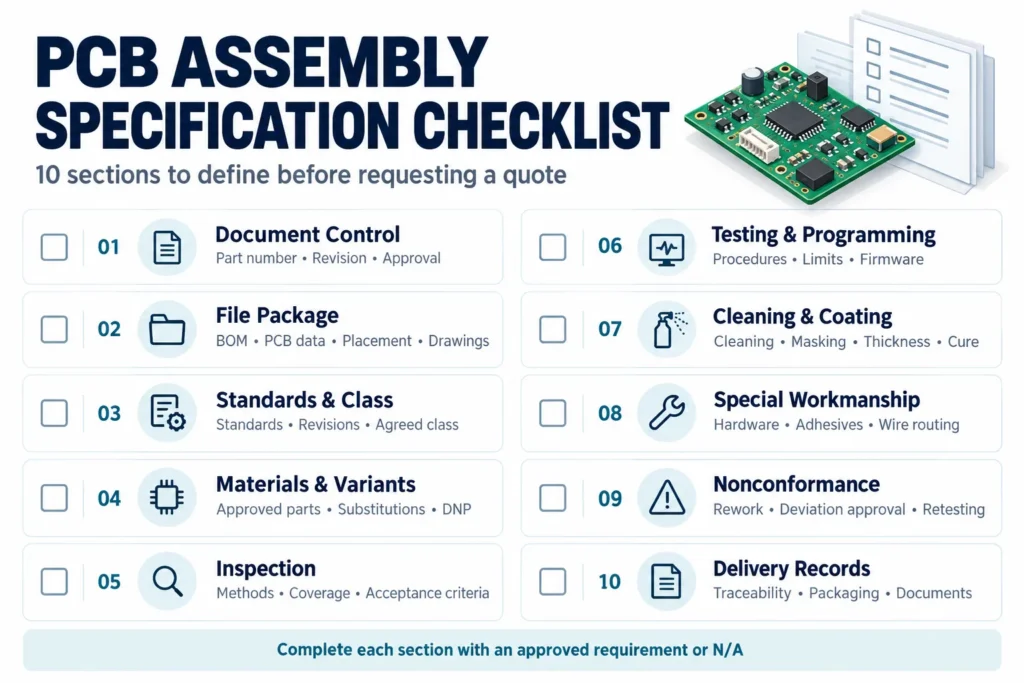
Use this checklist to structure a PCB assembly requirements document. Fill each section with an approved requirement or a clear “not applicable” decision.
Assembly Spec Checklist
| Section | What to Include | Why It Matters |
|---|---|---|
| Document control | Assembly number, revision, owner, approval, and effective date. | Identifies the authorized build requirements. |
| File package | BOM, PCB data, placement file, drawings, and their revisions. | Prevents mismatched production inputs. |
| Standards and class | Standard numbers, revisions, product class, and applicable addenda. | Defines the agreed workmanship baseline. |
| Materials and variants | Approved parts, substitutions, unpopulated positions, and solder requirements. | Controls what is assembled. |
| Inspection | Methods, coverage, criteria, sampling plan, and required reports. | Makes acceptance decisions repeatable. |
| Testing and programming | Procedures, limits, fixtures, firmware revision, and result records. | Defines verification beyond visual appearance. |
| Cleaning and coating | Residue requirements, material, masking, thickness, cure, and verification. | Clarifies protection and cleanliness expectations. |
| Special workmanship | Mechanical notes, adhesives, wire routing, and labeled exceptions. | Captures requirements specific to the design. |
| Nonconformance | Rework permissions, deviation approval, rejection handling, and retesting. | Prevents unauthorized disposition of problems. |
| Delivery records | Traceability, labels, packaging, and required shipment documentation. | Connects delivered units to the approved build. |
Before sending the RFQ, have engineering check technical intent and quality check acceptance criteria. Procurement should confirm that the quotation covers the requested work. Release one controlled package after open questions are resolved.
FAQ
What IPC class should I specify for my assembly order?
Choose the class based on operating needs and failure consequences. Have engineering and quality confirm it with the assembler. Record the standard, revision, class, and applicable addenda. An industry label alone does not determine the complete requirement.
What happens if I don’t provide an assembly specification?
The assembler may need clarifications or propose its own assumptions. Important work could remain outside the quotation. There is no universal automatic Class 2 default. Agree on standards, inspection, testing, and special requirements before releasing the order.
Should conformal coating requirements be included in the spec?
Yes, when coating is required. Define the material, coverage, keepouts, cured thickness, cure conditions, and inspection method. Include cleaning and compatibility requirements. If coating is unnecessary, state that clearly to prevent conflicting assumptions.
Can Benlida help draft an assembly specification for my order?
Share your draft requirements and manufacturing files for review with Benlida. The review can identify questions about workmanship, inspection, and production expectations. Your engineering and quality teams should approve the final product requirements before the build is released.
Want to Avoid Miscommunication on Your Order?
Benlida reviews your assembly specification against IPC class requirements before quoting to confirm expectations match production.
Explore our PCB assembly services. Share your assembly specification with the BOM, PCB files, placement data, assembly drawing, and test requirements. Include the quantity and revision for review.