

Year in Review — PCB Industry Trends and What to Expect

PCB Industry Trends Heading into 2027
PCB industry trends heading into 2027 point to denser designs, more demanding RF material choices, and closer attention to sourcing resilience. For buyers, these shifts make early engineering review and clear supply requirements increasingly useful. The practical goal is to match the board design, manufacturing process, and sourcing plan before committing to production.
This review covers evidence available through November 6, 2026. It looks at 2026 to date and draws practical implications for 2027 planning. The focus is on HDI, 5G materials, sourcing flexibility, and engineering support. Each trend matters differently to a compact sensor, a radio board, or an industrial controller.

Continued Push Toward Miniaturization and HDI
Smaller products often need more connections within the same board area. High-density interconnect, or HDI, helps designers manage that routing challenge. Microvias and finer features can provide space where conventional routing becomes difficult.
In its March 2026 technical program, MKS’ Atotech highlighted fine-feature manufacturing, HDI, and package substrates. It also emphasized reliability challenges in stacked microvias. This is a useful view of a process supplier’s technical priorities, rather than a measure of global HDI market growth.
The purchasing lesson is to review the proposed construction early. Ask the fabricator to explain the stackup, via arrangement, and inspection or qualification needs. A design that routes successfully still needs a manufacturing process suited to its geometry and operating conditions.
Advanced package substrates and HDI system boards also serve different roles. A supplier’s capability in one does not establish capability in the other. Specify the actual product and construction when requesting a quote.
Use HDI where the design needs it. A simpler board may still meet the product’s size, performance, and cost targets. Our IoT PCB design guide connects these layout choices with the wider needs of compact connected products.
5G and mmWave: More Specific Material Requirements
5G adoption provides a continuing reason to examine RF board requirements. In its June 2026 Mobility Report announcement, Ericsson reported 3.1 billion global 5G mobile subscriptions in the first quarter of 2026. That figure measures subscriptions. It does not measure mmWave use or sales of PCB materials.
The material decision depends on the actual circuit. GSMA’s May 2025 spectrum paper describes different roles for low-, mid-, and high-band spectrum. Millimeter-wave, or mmWave, serves selected high-capacity applications. A 5G label alone does not define the laminate needed for every board in a product.
For technical context, Rogers’ 2023 material-characterization article explains why material test methods and circuit behavior need to be considered together. Copper roughness and fabrication geometry can also affect electrical performance.
Buyers should therefore request more than a material brand name. Agree on the operating frequency, acceptable signal loss, dielectric properties, copper profile, and relevant tolerances. Confirm that the proposed construction can be manufactured and evaluated as intended.
A material substitution may change performance even when the board outline stays the same. Have engineering review the proposed grade and stackup before approval. Our 5G PCB design guide provides a more detailed starting point for that discussion.
Supply Chain Diversification and Sourcing Flexibility
PCB supply chain trends deserve a careful reading. The OECD’s July 2026 global value chain report, drawing on historical data through 2024, describes continuing international integration alongside changes in sourcing patterns. Diversification can involve additional suppliers and revised purchasing arrangements. It does not necessarily mean moving every product out of an established manufacturing region.
Materials can remain a constraint across several suppliers. In its October 2026 report on North American PCB activity, the Global Electronics Association’s chief economist highlighted supply constraints in copper foil, resin, and electronic glass fabric. The concern was especially relevant to high-performance grades. This regional observation supports checking current availability for each project; it does not establish a worldwide shortage for every board type.
For a practical sourcing plan, identify what could stop production. Two fabricators may depend on the same laminate producer. An alternative assembly partner may still need the same scarce component. Ask where critical inputs come from and what has already been qualified as a substitute.
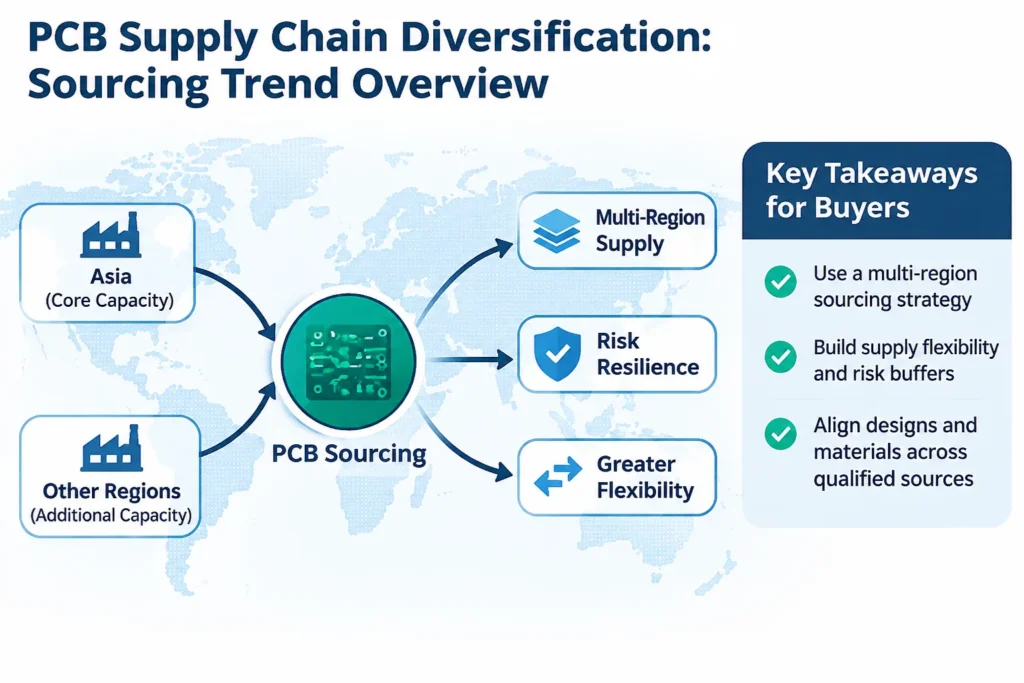
Keep bare-board sourcing separate from component sourcing. PCB fabrication needs approved materials and construction data. PCBA also needs an approved bill of materials and controlled component changes. Compare engineering communication, traceability, and change approval when assessing how to choose a PCB manufacturer in China.
Why Early DFM and Engineering Review Matter
A more complex design creates more decisions that purchasing and engineering must resolve together. Design for manufacturing, or DFM, helps check whether the intended board matches a supplier’s process. It is most useful while design choices are still open.
Siemens’ September 2026 discussion of manufacturing handoff emphasizes early manufacturer involvement and preserving design intent across revisions. The practical takeaway is to explain why important requirements exist, as well as supplying the files that describe them.
A productive review should identify the location of an issue, explain the manufacturing concern, and record the agreed action. If a proposed change affects impedance, mechanical fit, or component compatibility, the responsible engineer should approve it before release.
For fabrication, provide the manufacturing artwork, drill data, fabrication drawing, stackup, and special requirements. Assembly work also needs the BOM, placement data, assembly drawing, and testing requirements. Keep revision identifiers consistent across the package.
Benlida’s DFM review and engineering support provides a route for discussing these questions before quoting. Bring unresolved design and sourcing points into that discussion early.
What This Means for PCB Buyers in 2027
Use the PCB industry outlook to improve project questions. The future of PCB manufacturing will affect products differently, so a general trend should be translated into a specific requirement before it changes a purchasing decision.
Trend Impact
| Trend | Impact on Buyers | Relevant Service |
|---|---|---|
| Miniaturization and HDI | Review routing density, via structure, and qualification needs early. | HDI construction and stackup review |
| Application-specific RF materials | Specify operating conditions and approve material substitutions. | RF material and manufacturability review |
| Sourcing diversification | Check shared dependencies and qualify realistic alternatives. | Material and component sourcing review |
| Earlier engineering collaboration | Resolve design questions and align revisions before production. | DFM and manufacturing-data review |
Build a short action list for each planned project:
- Define what cannot change. Record electrical, mechanical, and material requirements that need engineering approval.
- Identify the main dependency. Separate laminate availability, fabrication capacity, component supply, and assembly scheduling.
- Prepare a usable backup. Agree on qualification steps before an alternative supplier or material is needed.
- Compare complete quotations. Check the revision, scope, testing, delivery assumptions, and exclusions alongside price.
Talk to our engineering team about the board requirements and sourcing questions that could affect your next build.
FAQ
What is the biggest PCB industry trend heading into 2027?
There is no single trend that leads every application. HDI is important for dense layouts, while RF performance and sourcing resilience matter more in other projects. Start with the product’s main constraint, then decide which manufacturing changes deserve attention.
How is 5G affecting PCB material demand?
Continued 5G adoption keeps attention on materials suited to RF applications. Requirements vary with frequency and circuit function. Subscription growth alone cannot quantify laminate demand, and mmWave material needs should be evaluated separately from other 5G boards.
Why are buyers diversifying PCB sourcing beyond one region?
Buyers may seek alternatives to reduce exposure to regional disruptions or individual suppliers. The benefit depends on actual dependencies. A second supplier that uses the same constrained inputs may provide less protection than expected, so qualification and supply visibility remain important.
What should buyers look for in a manufacturer given these trends?
Look for a process that matches the design, useful engineering feedback, clear sourcing communication, and controlled revisions. Ask what evidence supports the proposed construction and how changes are approved. Confirm the quotation’s scope before comparing price or delivery.
Planning Your 2027 PCB Sourcing Strategy?
Benlida combines engineering support with flexible Shenzhen sourcing to help buyers adapt as material and supply chain demands shift.