

How to Choose a PCB Manufacturer in China — Buyer’s Checklist

What to Look for in a China PCB Manufacturer
Choose a PCB manufacturer in China by checking project fit, relevant certifications, DFM support, communication, and documented quality controls. For assembled boards, also review component sourcing and substitution approval. Compare these points against a complete quote, rather than unit price alone.
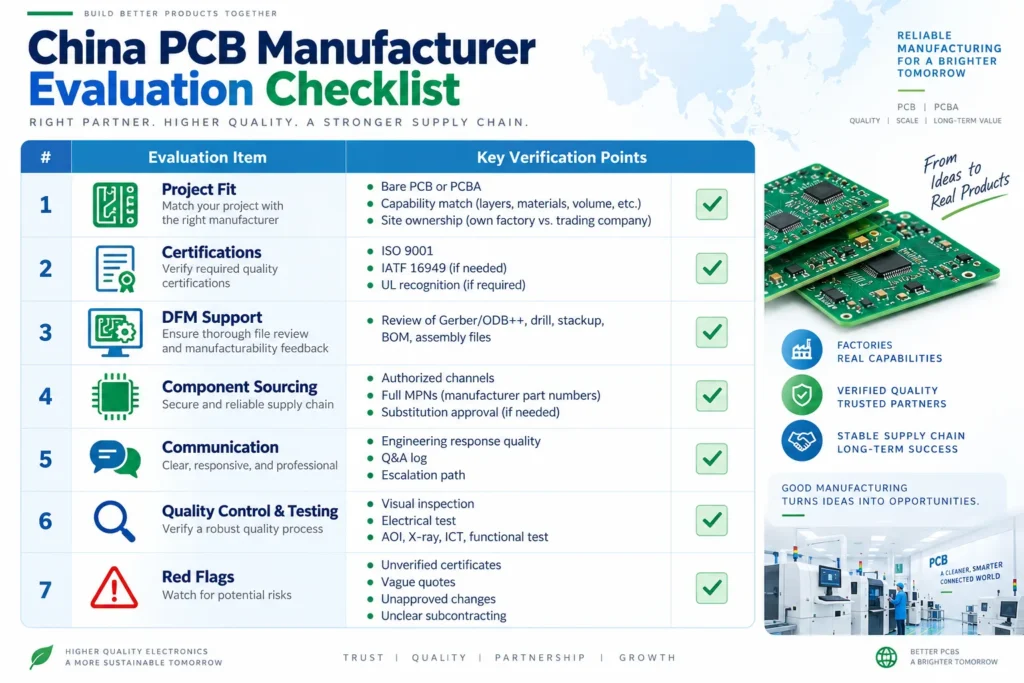
First, define what you are buying. PCB fabrication produces the bare board. PCBA adds component assembly and any agreed programming or testing. A supplier’s experience in one area does not establish its capability in the other.
Identify the manufacturing site and any subcontracted processes. Ask who owns technical decisions, quality records, and corrective action. A trading company or managed supply network is not automatically unsuitable, but its responsibilities should be clear.
Use this PCB manufacturer checklist for China-based suppliers to collect comparable answers. Record supporting evidence and unresolved questions, not just a yes or no.
Supplier Evaluation Checklist
| Criteria | Why It Matters | What to Ask |
|---|---|---|
| Project and factory fit | Capability must match the actual design. | Which site and processes will handle this board? What is outsourced? |
| Certification scope | A logo does not establish current coverage. | Can you provide verifiable certificates for the relevant entity, site, and activities? |
| DFM and change approval | Unresolved design risks can reach production. | What will you review, and how will we approve proposed changes? |
| Component sourcing | PCBA parts need controlled sources and substitutions. | What source records and alternate-part approval process will apply? |
| Engineering communication | Clear answers help resolve production questions. | Who handles technical issues, and when will they respond? |
| Inspection and testing | Different checks detect different problems. | Which checks, acceptance limits, and records are included in this quote? |
| Traceability and problem handling | Failures must be linked to affected builds. | How are revisions, lots, nonconformances, and corrective actions recorded? |
| Quote and delivery scope | Missing charges or assumptions distort comparisons. | What is excluded, and when does the production clock start? |
Send every shortlisted supplier the same revision, quantities, specifications, and delivery requirements. Separate board price from tooling, engineering, test fixtures, packaging, and freight. Confirm whether lead time uses working or calendar days and whether it excludes transport.
Certifications to Verify (ISO 9001, IATF 16949, UL)
Start with the requirements of your product and customer. Do not collect certification logos as a substitute for checking scope.
ISO 9001 concerns quality management systems. It is not certification of an individual PCB or a guarantee that every shipment is defect-free. Request the certificate and check the legal entity, manufacturing address, covered activities, certificate number, and current status with the issuing body.
Check the standard edition and any applicable transition arrangements. A newly published edition does not, by itself, prove that an older certificate has become invalid. Ask the issuer to confirm its status rather than relying only on a website image.
IATF 16949 addresses quality management in the automotive supply chain. For automotive programs, confirm whether it and customer-specific requirements apply to the manufacturing site and supplied product. It is not a universal requirement for every PCB order. An automotive application listed on a supplier’s website is not evidence of certification.
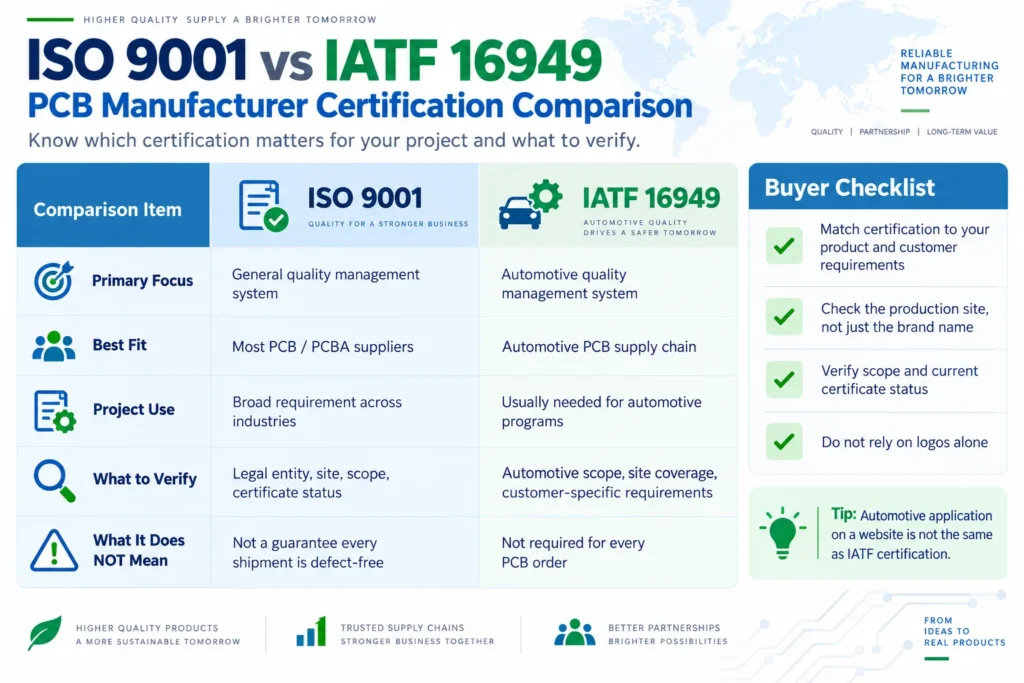
Where UL recognition is required, use the UL printed wiring board database to check the supplier’s file and covered board types. Ask for evidence that your materials, construction, ratings, and production site fall within the applicable recognition. A recognized PCB does not automatically make the assembled product UL certified.
Keep certificates and verification dates in your supplier file. Resolve any mismatch between the quoted factory, certificate holder, and manufacturing location before approval.
DFM Support — Does the Manufacturer Review Your Design?
Design for manufacturability, or DFM, checks whether a design fits the intended manufacturing process. Ask what the review covers, when it happens, and what you receive. A useful response identifies the affected feature, explains the risk, and proposes a specific action.
For bare boards, discuss trace spacing, hole sizes, annular rings, copper-to-edge clearance, stackup, and fabrication tolerances. Add impedance requirements or special materials where relevant. For PCBA, separately confirm assembly checks such as component spacing, polarity, footprints, and access for testing.
The PCB DFM checklist can help you prepare the review package. Include Gerber or ODB++ data, drill files, a fabrication drawing, and clear revision information. PCBA projects also need the BOM, placement data, and assembly instructions.
Ask how engineering questions are recorded and closed. The supplier should not silently change materials, copper features, holes, or footprints. Agree which changes require your written approval and how the released files will be identified.
When discussing DFM review with Benlida, confirm the project scope, required inputs, charges if any, and review timing. Do not assume that a standard file check includes circuit redesign, simulation, or product validation.
Early review can avoid some preventable revisions. However, passing DFM does not prove electrical performance, regulatory compliance, or long-term reliability.
Component Sourcing Flexibility and Substitution Support
This check applies when your order includes component procurement or PCBA. Clarify whether the supplier buys all parts, shares procurement with you, or assembles customer-supplied material. Identify who handles shortages, excess stock, damaged parts, and unusable supplied components.
Ask for full manufacturer part numbers and the proposed purchasing channels. TI’s authorized purchasing guidance explains the risks of buying its products outside authorized channels. Apply a documented sourcing policy to your BOM rather than treating a low price or available stock as proof of authenticity.
Review component sourcing flexibility alongside substitution controls. An alternate may differ in package, pinout, voltage rating, tolerance, temperature range, or firmware behavior. Renesas cautions that cross-reference suggestions may not be pin-compatible and require further checking.
Require engineering approval before an alternate enters the build. Keep the proposed part number, comparison, validation decision, and BOM revision together. For traceability, agree which supplier, lot, date-code, and receiving records will be retained and how they link to the assembly batch.
Availability changes. Ask which parts are actually reserved for your order and how shortages or substitutions will affect the confirmed schedule.
Communication and Engineering Responsiveness
Test communication before paying for a large order. Send a real technical question with the relevant drawing excerpt. Evaluate whether the answer addresses your design, identifies assumptions, and names the person responsible for follow-up.
A fast acknowledgment is useful, but it is not a technical resolution. Agree a response window that accounts for time zones and local holidays. Confirm who handles urgent issues if the normal contact is unavailable.
Use one controlled question-and-answer log. Record the question, affected revision, proposed change, owner, and approval status. After a meeting, ask for a written summary that matches the agreed drawings and quote.
Also ask how the supplier reports delays. A useful update states what changed, which milestone is affected, what options exist, and when the next update will arrive. These habits matter more than promises of constant availability.
Confirm how design files are shared and who can access them. Agree confidentiality arrangements and any restrictions on sharing files with subcontractors before sending sensitive project data.
Quality Control and Testing Capabilities
Ask for a project-specific inspection and test plan. Equipment photographs show possible resources, not which checks your order includes. Request a redacted report example and confirm the limits, sampling or full-test scope, and records you will receive.
For bare PCBs, distinguish visual inspection, dimensional checks, and electrical continuity and isolation testing. Additional work, such as impedance measurement or microsection analysis, needs an agreed specification. Bare-board electrical testing cannot verify installed components or firmware.
For PCBA, automated optical inspection checks visible assembly features. X-ray inspection can examine selected hidden structures. In-circuit testing checks selected components and connections, while functional testing exercises defined behavior. None of these methods, on its own, establishes complete fault coverage.
Specify the applicable standard, revision, and product class in the purchase requirements. IPC’s standards guide distinguishes bare-board requirements from assembly acceptance. For example, IPC-6012 concerns rigid PCB qualification and performance; IPC-A-610 concerns electronic assembly acceptance. An ISO certificate does not replace either set of project requirements.
Use Benlida’s PCB and PCBA quality control information to frame questions about your intended build. Request the relevant records and confirm which activities are included, optional, or performed by another organization.
Before a larger commitment, consider a pilot build using the intended production process. Check the delivered revision, inspection records, test results, and response to problems. Agree how nonconforming units are contained, investigated, and resolved. A successful pilot supports the decision but does not guarantee future reliability.
Red Flags When Evaluating a New Supplier
Pause supplier approval when important questions remain unresolved. Examples include:
- Certificate details cannot be verified or do not match the proposed production site.
- A quote omits materials, acceptance requirements, test scope, or major charges.
- Engineering concerns receive generic assurances without a documented resolution.
- Substitute components or design changes appear without approval.
- The supplier will not explain subcontracting, traceability, or corrective-action responsibilities.
- Production is promised before critical files, materials, or technical questions are resolved.
A missing website detail is a reason to ask for evidence, not proof of misconduct. Likewise, a low quote does not automatically mean poor quality. Compare its assumptions with the other offers and request clarification.
Separate mandatory requirements from preferences. A missing required qualification should not be offset by a lower price or a faster email. Shortlist suppliers whose evidence matches your project, then use the pilot results and unresolved risks to guide approval.
FAQ
What certifications should a PCB manufacturer in China have?
It depends on the product, customer, and manufacturing scope. ISO 9001 addresses quality management. IATF 16949 may be required for automotive supply, while UL recognition may apply to specified board constructions. Verify the relevant entity, site, scope, and status. None is a universal guarantee of product quality.
Why does DFM review matter when choosing a supplier?
It shows how the supplier identifies manufacturing risks and communicates proposed changes before production. Ask for a clear review scope and a controlled approval process. DFM can help prevent avoidable rework, but it does not replace circuit testing or product validation.
How do I evaluate communication quality before placing an order?
Submit a real technical question and compare the answer with your drawing or specification. Look for clear assumptions, a responsible owner, and written follow-up. Agree response expectations, escalation contacts, and how file revisions will be controlled across time zones.
What are common red flags when vetting a China PCB supplier?
Unverifiable certificates, unclear manufacturing locations, incomplete quotes, unapproved substitutions, and unexplained test coverage deserve investigation. Ask for supporting records and a resolution before committing. Refusal to clarify a requirement is more concerning than a missing detail on a marketing page.
Evaluating PCB Manufacturers in China?
Send Benlida your board files, fabrication requirements, quantities, and required delivery date. For PCBA, include the BOM, placement data, and test or programming requirements. Ask the team to confirm DFM scope, sourcing options, applicable quality documentation, and the engineering contact for your project.