

Obsolete and Long-Lead Components in PCBA — Your Options

How to Handle Obsolete Components in PCBA and Parts With Long Lead Times
To source long-lead or obsolete components for PCBA, first check the manufacturer’s status for the exact part number. If the part is still in production, ask an authorized source what quantity it can deliver by your build date. If production is ending, compare an approved alternate, a candidate that needs qualification, and a last-time buy. Give the assembler your approved parts list before it buys material.
One late component can hold up an otherwise complete assembly kit. Purchasing needs to know whether to expedite the specified part, wait for engineering to release a substitute, or move the build. Give purchasing the quantity needed for the first run and the date the parts must reach the assembler. A quoted factory ship date still leaves transit and receiving time.
Component Lifecycle Status and What Each Label Means
Look up the full manufacturer part number (MPN), including the ordering suffix. Parts in one family can differ in package, temperature grade, or packing format. Compare the ordering code with the affected-parts list in the manufacturer’s notice. A distributor showing zero stock tells you about that source’s inventory. The manufacturer tells you whether production continues.
Texas Instruments’ lifecycle definitions distinguish active parts, parts not recommended for new designs (NRND), parts in a last-time-buy window, and obsolete parts. An active part can still have a long lead time. An NRND part can still support an existing design. An obsolete part is out of production, although an authorized distributor may have stock left. When you see “end of life” (EOL), open the discontinuance notice to check which ordering codes and deadlines it covers.
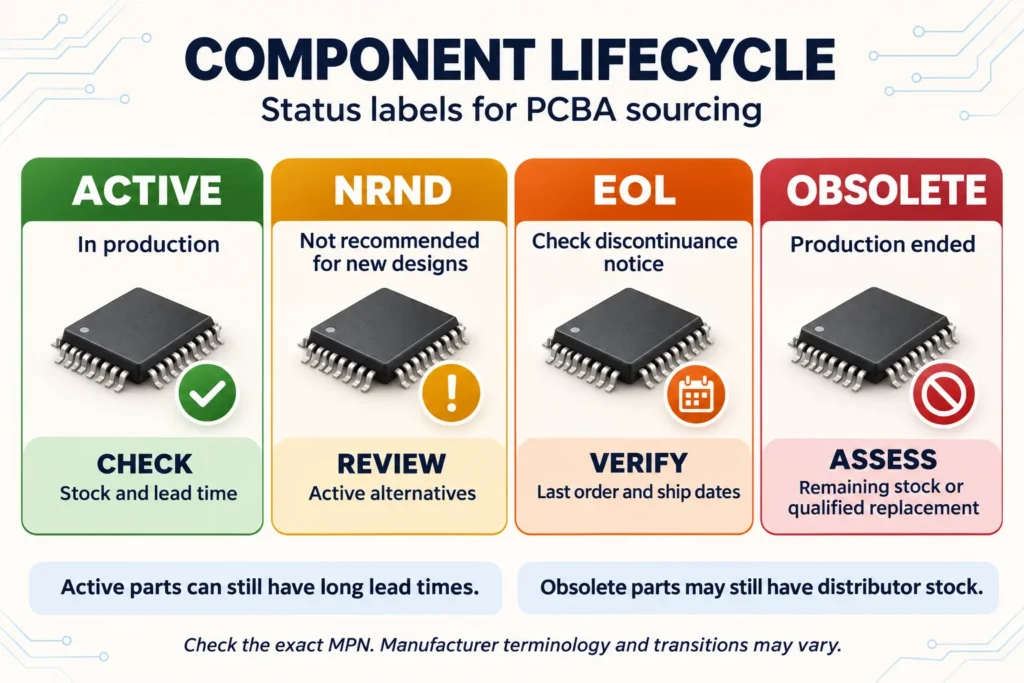
How to act on a shortage or lifecycle notice
| Situation | Best action | Who must approve | Main risk |
|---|---|---|---|
| Active part arrives too late | Check other authorized stock and split deliveries of the same MPN. | The buyer approves the purchase. Production planning confirms any schedule change. | The first shipment is too small to complete the planned run. |
| NRND part on a released board | Confirm supply for this revision and evaluate an active part for the next. | The design owner approves a change to the released parts list. | The next revision inherits a part with limited future support. |
| An approved alternate is available | Match its full MPN to the approval for this board revision and check any lot or quantity limits. | The buyer can order within the existing design approval and purchasing authority. | An approval for a prototype gets applied to production. |
| A cross-reference search suggests a candidate | Compare datasheets and resolve any differences before releasing it. | The project’s designated technical approver. | A pin, rating, or software difference prevents the board from working. |
| EOL notice with an open order window | Estimate demand through a redesign or the end of service, then verify order terms. | The demand owner confirms quantity. The buyer approves the commitment. | Excess stock, or too few parts to cover the transition. |
| Obsolete part with no approved stock source | Check traceable remaining stock or plan a qualified replacement or redesign. | The designated source approver handles any source exception. Engineering approves a part change. | Unverified material or a redesign that misses the build date. |
Match these roles to the approval authority on your project. A buyer may accept a delivery date or an order minimum while the customer’s hardware engineer retains control over changes to the circuit.
Alternates, Cross-References, and Form, Fit, and Function
A component cross-reference gives engineering a part to investigate. An approved alternate has already been accepted for a defined use. When evaluating alternative parts for a PCB BOM, check what the assembly needs to fit its enclosure, pass production tests, and work in the field.
- Form. Compare the package drawing, body height, terminal style, and orientation. A taller part may fit the solder pads and still foul the enclosure.
- Fit. Check the land pattern, pin assignments, and exposed pad connection. For a connector, check the mating part, keying, and latch direction as well.
- Function. Compare limits under the board’s operating conditions. For a programmable device, include startup behavior, firmware support, and any change to the production test.
Take the ceramic capacitor on a regulator output. A candidate may match the original’s nominal capacitance, rated voltage, and footprint. The effective capacitance can still fall under DC bias. Check the candidate’s capacitance curve at the actual rail voltage against the regulator’s stability requirement. Murata explains how applied DC voltage affects ceramic capacitance and where to find the relevant curves.
When a Last-Time Buy Makes Sense
A last-time buy can cover production and repairs until a replacement is qualified or service ends. Choose a planning date. Count the assemblies you expect to build from that date through the transition and multiply by the parts used per board. Add expected assembly losses and service demand. Subtract uncommitted, usable stock on the planning date and confirmed receipts that will arrive in time. Agree on the forecast with the people responsible for production and repairs before committing funds.
Check the last order date and last shipment date separately. In its discontinuance notice for the LC709204FXE-01TBG, onsemi set February 2, 2026, as the final order date and December 31, 2027, as the final ship date. It listed no replacement for that part and specified noncancelable, nonreturnable orders. The later date allowed time to ship orders already accepted. Purchasing had to act by the earlier date.
Before accepting those terms, ask what quantity the source can commit, how it will package the material, and who will hold the stock. If future demand varies widely or authorized stock falls short, get an estimate for redesign and qualification alongside the cost of the final purchase.
How a PCBA Supplier Handles Substitution Approval
Benlida’s alternative component sourcing process starts with the BOM, the original specification, the quantity, and the supply issue. The team checks qualified sources for candidates, compares their specifications and packages, and reviews suitability for the application and assembly process. Purchasing and supply preparation follow the approval agreed for the project.
If a candidate is new, ask for the original and proposed ordering codes, datasheet links, the relevant differences, and the quantity available by the build date. That gives the design owner a specific decision. For the regulator example, approval might depend on a capacitor curve or a bench check under load. If the change is accepted for a pilot run only, record that limit before purchasing releases the order.
A change of seller raises a separate question even when the MPN stays the same. Ask who supplied the lot and what records connect it to the manufacturer. If the source falls outside your approved channels, let the person responsible for supplier quality review the traceability records before you accept the lot.
What to Put in Your BOM to Avoid Sourcing Delays
Give the assembler a released bill of materials (BOM) with separate fields for the original MPN, the approved alternate MPN and manufacturer, and any limitations. Add the applicable revision, approval reference, and decision owner. Keep proposed parts clearly marked as pending until the authorized person releases them.
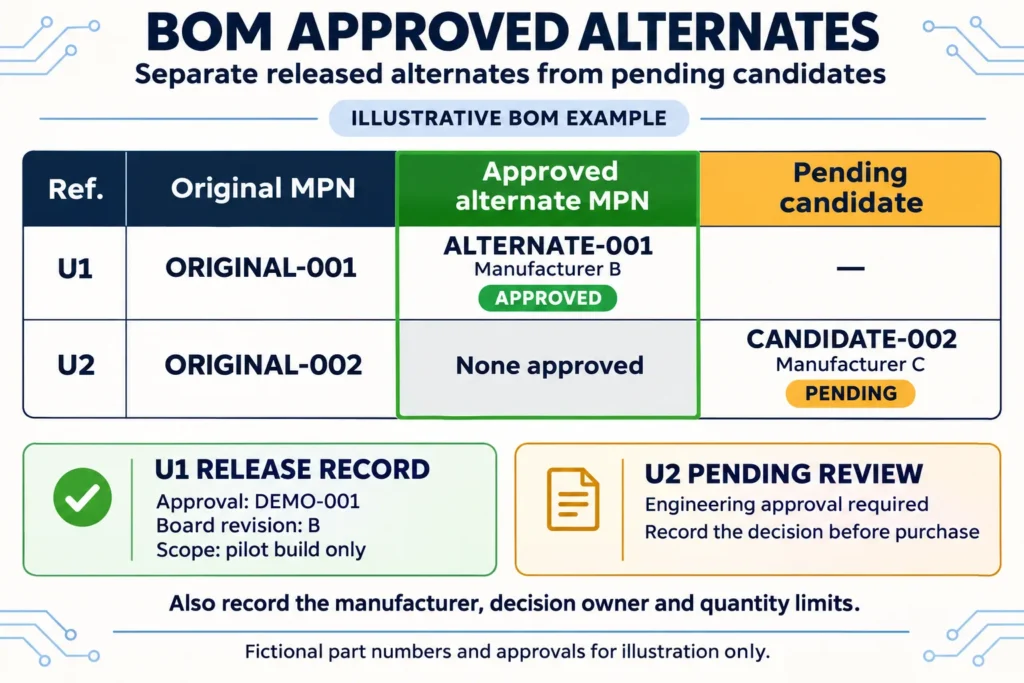
Consider how a buyer would read this illustrative temperature-sensor entry. The ordering codes are real. The approval status illustrates a design decision.
Example BOM entry while a proposed sensor is under review
| Specified part | Approved alternate | Candidate | Open engineering check |
|---|---|---|---|
| TI LMT84DCKR | None approved | TI LMT85DCKR | Compare output curves and check the firmware’s temperature conversion. |
The output voltage changes by a different amount per degree on each sensor. A controller that uses the original sensor’s voltage-to-temperature conversion could report the wrong temperature with the candidate installed. Keeping that part in the candidate column lets procurement check availability while engineering evaluates the change.
Include the quantity per assembly, planned lot size, and required arrival date with the RFQ. The PCB BOM preparation guide covers the rest of the file. If you plan to supply scarce parts yourself, identify those lines up front. Our guide to turnkey vs partial PCB assembly explains how to divide purchasing responsibilities. Send us your BOM with the affected lines marked so the team can quote the right scope of PCB assembly services.
FAQ
What does NRND mean for a component?
NRND means “not recommended for new designs.” The manufacturer may still supply the part for existing products. Check the exact ordering code and ask for availability against your next build. For a new board or a major redesign, evaluate an active alternative while the layout and qualification plan are still flexible.
Can a PCBA supplier replace an obsolete part with an alternate?
Yes, when the alternate is covered by the project’s approval. A supplier can source an MPN already released for that board revision or propose a new candidate for review. Check who has technical approval authority and whether the acceptance covers a single build or continuing production before releasing the purchase.
What is a last-time buy?
A last-time buy is a final opportunity to order a component during the manufacturer’s discontinuance process. The notice identifies the affected parts and gives the order deadline. Confirm delivery commitments, order terms, and available quantity with the source. Base the purchase on demand through the redesign or service period.
How do I avoid long-lead delays on a new BOM?
Flag components with long lead times during part selection and check availability at your planned production quantity. Qualify alternates while the design can still change. Give the assembler the approved ordering codes, release quantities, and required dates. Recheck availability before the order because stock shown during design may already be committed.
Stuck With an Obsolete or Long-Lead Part?
Benlida’s Shenzhen sourcing team checks alternates and availability for your BOM.