

PCB Assembly from China — What to Expect and How to Prepare
What to Expect When Ordering PCB Assembly from China
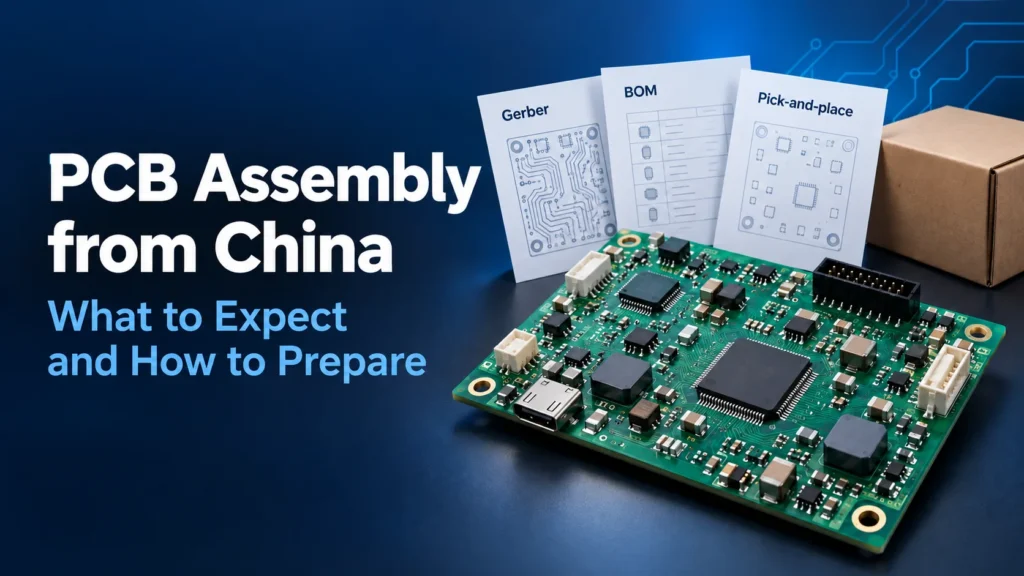
Ordering PCB assembly from China typically involves a 4–5 week sales cycle from first contact to delivery. Engineering review of your design files takes place within about a week. Communication is primarily over email or messaging platforms with the supplier’s engineering team. First-time buyers should prepare complete Gerber, BOM, and pick-and-place files upfront to avoid delays during the quoting stage.
This PCB assembly from China guide focuses on preparing your first order. A PCB is the bare circuit board. A PCBA is the board after components have been assembled. A bare-board quotation therefore does not describe the full cost or schedule of an assembled product.
Start by agreeing on who supplies each item. Turnkey scope should clearly identify responsibility for boards, components, assembly, testing, and delivery. With consigned assembly, you supply specified materials. Partial turnkey divides purchasing responsibilities. When reviewing PCB assembly services, confirm which arrangement applies to your project.
Typical Sales Cycle and Lead Time Timeline
A first inquiry and a released production order have different starting points. The first may still contain unresolved design questions. The second needs an agreed build package and commercial terms. Ask what event starts the quoted production clock.
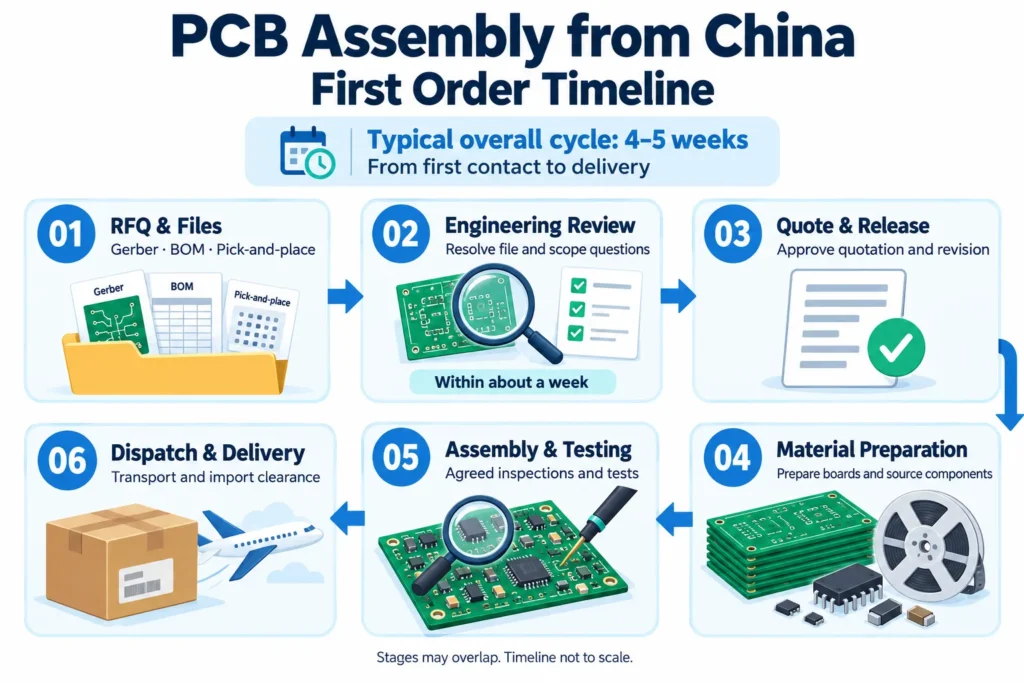
The typical sales cycle runs for 4–5 weeks from first contact to delivery. Engineering file review takes place within about a week. The timeline below shows how the main stages fit into that overall cycle.
First Order Timeline
| Stage | Typical Duration | What Happens |
|---|---|---|
| Overall order cycle | Typically 4–5 weeks. | Progress from first contact through review, sourcing, production, and delivery. |
| Engineering file review | Within about a week. | Review design files and resolve missing information, specifications, and scope. |
| Quotation, release, and material preparation | Within the overall order cycle. | Approve the quotation and revision, prepare boards, and source components. |
| Assembly and testing | Within the overall order cycle. | Assemble boards and perform the specified inspections and tests. |
| Dispatch and delivery | Within the overall order cycle. | Release the shipment, arrange transport, and complete import formalities. |
The overall cycle includes the stages below it; their durations should not be added to the total. Some activities can overlap. Keep factory completion, carrier transit, and customs processing distinct when tracking progress from first contact to delivery.
For example, an assembly estimate may assume that every component is already available. If one microcontroller remains unconfirmed, the estimate does not establish a dependable dispatch date. Ask the supplier to identify that dependency. Compare the original part’s availability with any approved alternative before deciding how to proceed.
For a deadline-driven project, give the required arrival date and destination at the RFQ stage. Ask about factory closures and the effect of delayed approvals. Confirm the schedule again when materials and engineering questions are resolved.
Communication Norms with Chinese Manufacturers
Agree on communication channels early. Email is useful for quotations, file releases, and formal approvals. Messaging or video calls can help resolve urgent questions. Summarize decisions in the project record so everyone works from the same instructions.
Ask for a commercial contact and an engineering contact. Confirm their working hours and your shared meeting window. Write dates in an unambiguous format, such as 2026-11-05, and include the time zone for deadlines.
Send technical questions as a short list with reference designators, screenshots, and the affected revision. Separate requests for information from approvals. An acknowledgment such as “received” should not be treated as production authorization.
Useful status updates identify what is complete, what is blocked, who must act, and the next decision date. If the supplier requests clarification, answer all related questions together where possible. This reduces repeated exchanges without assuming that every supplier follows the same communication style.
File Preparation — Gerber, BOM, and Pick-and-Place
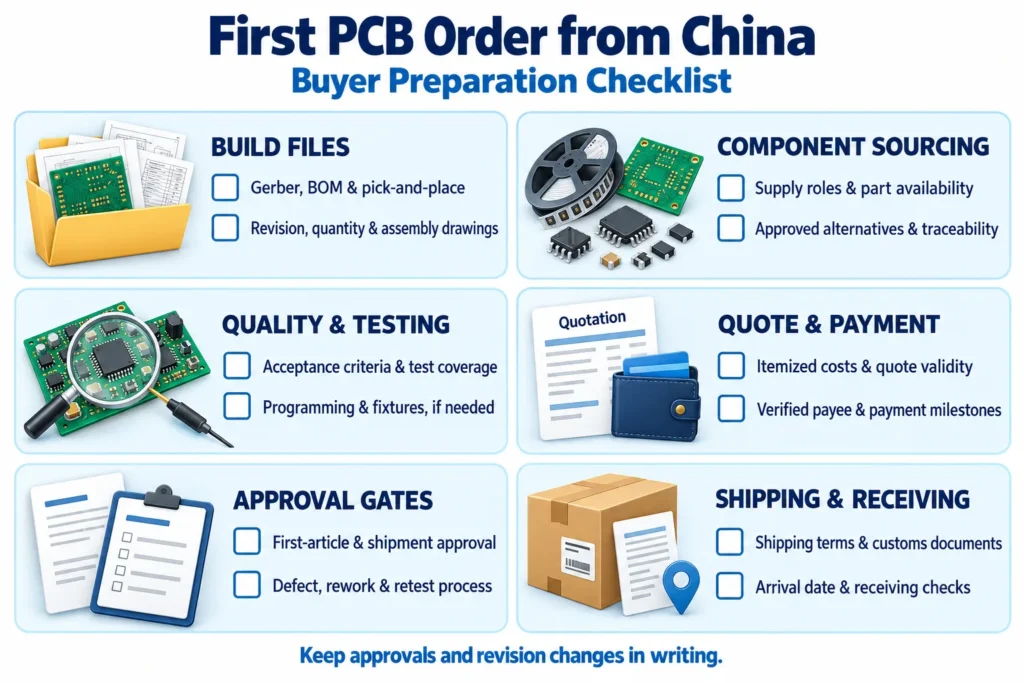
Create one controlled release package. Label the project, revision, assembly variant, and quantity. Include a file list so the supplier can confirm receipt. Remove obsolete versions from the package.
If a change is necessary after quotation, issue an updated release with a clear change list. Ask the supplier to confirm cost and schedule effects before proceeding. Record whether any boards or parts have already been ordered. An updated BOM should not silently replace a previously approved build.
- Bare-board data: Gerber or an agreed alternative format, NC drill files, and a fabrication drawing. Specify layers, material, thickness, copper, finish, and special requirements.
- Bill of materials: Reference designators, quantity per board, manufacturer, full manufacturer part number, description, and package. Clearly mark do-not-populate positions.
- Placement data: Component references, X/Y coordinates, board side, rotation, units, and the agreed coordinate origin.
- Assembly instructions: Drawings showing orientation, polarity, pin 1, and any manual operations or mechanical parts.
- Test and programming instructions: Firmware revision, programming method, required fixtures, test steps, limits, and expected records.
Use the PCB BOM preparation guide to check purchasing information. The PCB Gerber file guide covers the bare-board manufacturing package.
Do not assume every placement export uses the same reference convention. Altium’s assembly-data documentation distinguishes component-center, footprint-origin, and pad-1 coordinates. Confirm the chosen fields with the assembler. Cross-check orientation against the assembly drawing.
Component substitutions need written engineering approval. Matching package sizes or nominal values alone does not establish compatibility. State whether alternatives are permitted and identify who can approve them.
Ask how sourcing records will be retained. For example, Texas Instruments recommends buying its parts through authorized sources to reduce counterfeit risk. Confirm the proposed channels and required traceability for your BOM before purchasing begins.
Quality Assurance and Certification to Verify
Request quality evidence that matches the work being quoted. For an ISO 9001 claim, check the certified legal entity, site, scope, and current status. Follow ISO’s guidance on verifying certification through the issuing body or an appropriate database. A management-system certificate does not certify the performance of your individual board.
Agree on applicable assembly requirements. IPC distinguishes J-STD-001 soldering requirements from IPC-A-610 post-assembly acceptance criteria. Specify the agreed revision and class. Avoid relying on a broad statement such as “IPC quality.”
Ask which inspections and tests are included in the quotation. Automated optical inspection checks visible features. Hidden joints may require another method. OMRON’s X-ray inspection discussion explains why joints beneath components can be difficult to inspect optically.
Inspection does not automatically verify product function. Define functional test conditions, limits, and responsibility for fixtures and software. Confirm whether each check covers every board or a sample, and which results you will receive.
Ask for a sample report format before ordering. It should make the tested revision, lot or unit identification, method, and result clear. Define the process for reporting failures, approving rework, and retesting affected units.
Shipping, Payment, and Customs Considerations
Confirm the shipping method, named destination, insurance, and import-clearance responsibilities. Write the chosen trade rule and version into the order. ICC’s explanation of Incoterms 2020 covers delivery obligations, costs, and risk allocation. Payment terms and ownership transfer need separate agreement.
Confirm the invoicing company, beneficiary, currency, payment milestones, and bank fees. Resolve unexplained differences between the supplier and payment recipient before transferring funds. If bank details change, use an independently verified contact number. The FBI recommends checking payment changes directly rather than relying on the email alone.
Ask your customs broker to review the product description, classification, origin, and customs value before shipment. Confirm importer responsibilities and current destination charges. Do not assume every assembled board uses the same customs classification.
EU buyers can check registration and documentation needs through the European Commission’s import guide. Canadian buyers can follow the CBSA’s commercial import steps. U.S. buyers should confirm their shipment’s requirements with their broker before dispatch.
Request a commercial invoice and packing list that match the shipment. Agree on protective packaging and carton identification. Include freight, insurance, applicable duties, taxes, and brokerage in the landed-cost comparison.
How to Reduce Risk on Your First Order
Use a small initial build when it suits the project. Agree on what must pass before a larger release. A successful sample is useful evidence, but later batches still need controlled materials, revisions, and checks.
For broader supplier evaluation, read how to choose a PCB manufacturer in China. Then confirm the assembly-specific details for your order:
- Separate board, component, assembly, tooling, testing, and shipping charges.
- Record quote validity, component availability, and any noncancelable material commitments.
- Agree who owns fixtures, stencils, and unused components.
- Close design questions and approve substitutions before production release.
- Define first-article approval, shipment release, and the handling of rejected units.
- Agree confidentiality terms and the channel for sharing design files.
Compare quotations against the same scope. A lower total may exclude a test, fixture, or delivery charge. Ask suppliers to identify exclusions explicitly. Keep the approved quotation and release files together for later reference.
Plan receiving checks before the shipment arrives. Match quantities, labels, revisions, and agreed test records to the purchase order. Record any damage and retain packaging when investigating a shipping issue. For a technical failure, share the affected unit identification and reproducible test conditions with the supplier.
FAQ
How long does PCB assembly from China typically take?
The typical sales cycle is 4–5 weeks from first contact to delivery. Engineering review of your design files takes place within about a week. Prepare complete Gerber, BOM, and pick-and-place files upfront to avoid delays during quotation. The overall cycle includes delivery, not only factory production.
What files do I need to prepare before requesting a quote?
Prepare Gerber and drill data, a fabrication drawing, BOM, pick-and-place file, and assembly drawings. Add quantity, revision, sourcing responsibilities, and test requirements. Include programming instructions when needed. All files should describe the same approved build.
How do Chinese PCB manufacturers usually communicate with overseas buyers?
Agree on email, messaging, or video channels with the supplier. Keep quotations, revision releases, and approvals in a written project record. Name the commercial and technical contacts. Confirm working hours, time zones, and the expected response schedule.
What should I verify before paying for my first order?
Verify the contracting company, payment beneficiary, approved revision, scope, component plan, test requirements, and delivery terms. Check relevant certificates and their scope. Confirm payment milestones and the process for resolving defects. Independently verify any change to payment instructions.
Placing Your First PCB Order from China?
Benlida’s engineering team responds within 24 hours on weekdays and reviews your files for completeness before quoting.
Start your first order with Benlida by sharing your proposed build package, quantity, destination, and required arrival date. Include any sourcing restrictions and testing needs.